A half-cell battery is a virtual test bench, enabling researchers to trial one electrode at a time. Much work has been done on lithium-ion batteries using this approach. We explain the principles behind this model, before sharing some remarkable success with a lithium-sodium half cell battery.
Principles Behind Half Cell Batteries
A regular battery produces electricity from chemical reactions between two active electrodes. In a half-cell battery, though, only one electrode is the material of interest. The second electrode serves mainly as a stable reference point.
This arrangement allows researchers to accurately measure how efficiently the test material stores, and then releases energy. Scientists’ perception is clearer without the other material clouding their understanding of what is actually happening.
We’ll apply this theory to a lithium-sodium half cell battery in a moment. But first, let’s consider pure lithium research. There a researcher may, for example, develop a new lithium-ion battery anode.
They may then test their trial anode in a half-cell battery, in conjunction with a lithium-metal reference cathode. The researcher could then confidently ascribe changes in charging speed, energy capacity, lifespan, and stability to their experiment.
The main advantage of a half-cell battery is therefore its simplicity. It helps isolate problems, and improves understanding of the behavior of a single material better. Half-cells are also cheaper and faster to build than full batteries for laboratory experiments.
Applying this Model To Sodium And Lithium
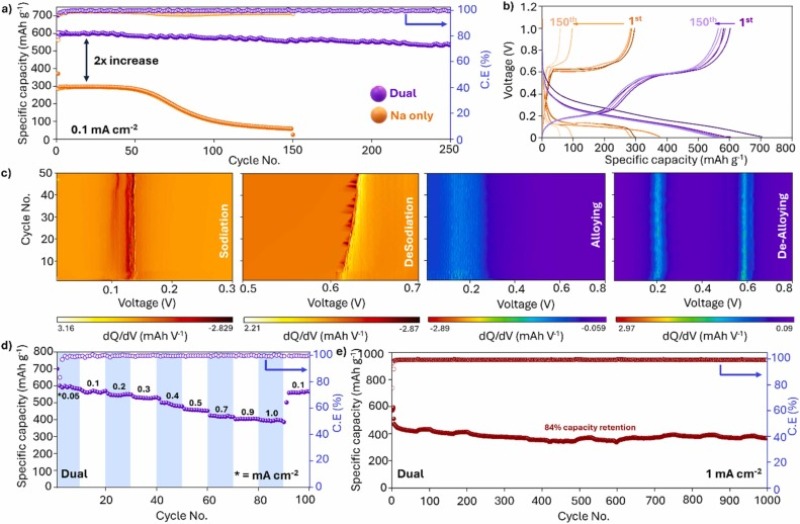
A team of scientists used a lithium-sodium half cell battery, to decide whether sodium could replace lithium in batteries. They concluded that lithium was more powerful, although it lacked the stability of sodium.
So the researchers developed a battery that combined the strengths of both of these two metals. Their idea could lead to more sustainable batteries, while also reducing pressure on the lithium supply chain.
Their research report, which we link to below, confirms that their experiment doubled traditional sodium battery capacity. They were also able to fully charge and discharge their prototype 1,000 times, before this capacity faded.
The interplay between sodium and lithium ions was intriguing. Lithium opened smoother pathways for sodium to follow. While the sodium-ions helped make sure that more lithium ions found their way home.
More Information
Could Sodium-Ion Rival Lithium-Ion?
First Dual Lithium-Sodium Battery
Preview Image: Dual Cation Mechanism