Customers sometimes ask us to provide a definition for one or other of the above terms. But we thought it might be more useful to lump the set together to avoid confusion. Read on if you would like to compare voltage current power and capacity. We’ll do our best to explain these terms in as few words as possible.
Comparing Voltage Current Power and Capacity Briefly
VOLTAGE
Firstly, voltage is the impetus with which a battery shuttles its electrons. Engineers describe voltage as the difference in the potential with which the anode and the cathode exchange them. Therefore, a higher voltage rating means the given electrons can do more work.
CURRENT
By contrast, current refers to the number of electrons traveling through the external circuit at any one time. Or if you prefer, the number of ions shuttling through the electrolyte. A higher current rating means more electrons to do more work.
POWER
Power is a measure, as opposed to a phenomenon. We calculate it by multiplying voltage by current. Both of these factors are important indicators of what a battery can do. We should therefore use this information to help us decide which battery is best for our application.
CAPACITY
Capacity expresses the above dimensions over time. In other words, for how long the battery will be able to power the application at that rate. One with a higher capacity should be able to do this comfortably for longer, than a lower capacity one. Drawing too much power reduces that capacity.
Adding One More Factor, Density to the Mix
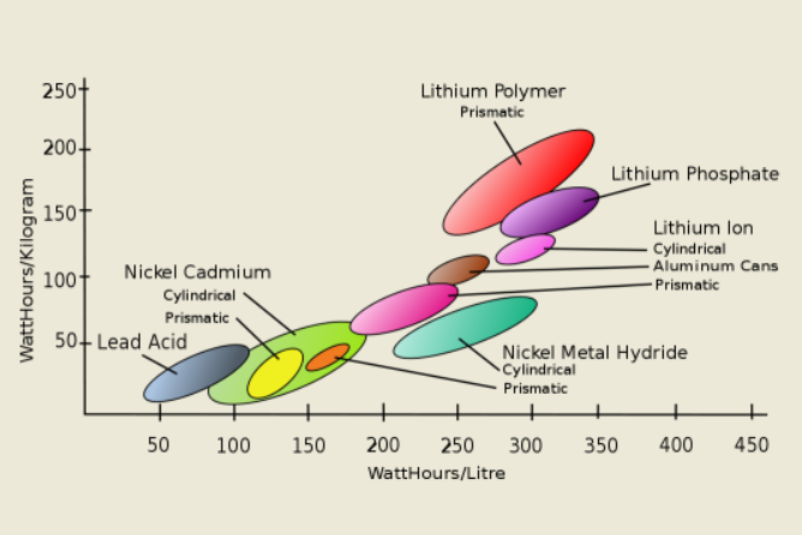
Voltage current power and capacity all have a role to play in battery performance, as defined by Australian Academy of Science (see link below). We believe we should mention one more measure, density in closing. Density is the amount of energy a device can hold per unit of volume. In other words, how big is the battery physically? This matters a great deal too.
Breaking News
Battery Memory Effect and Self-Discharge
Standard Potentials for Half Reactions