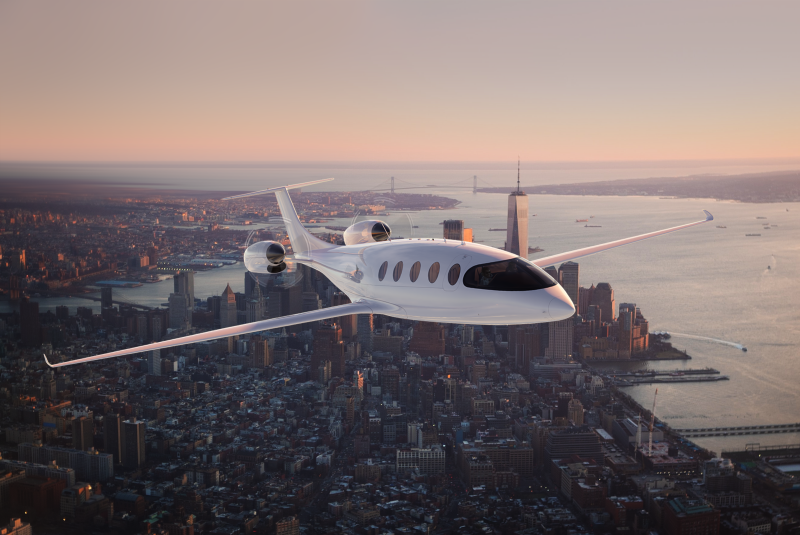
Aviation developer Eviation exhibited a nine-passenger aircraft at the 2019 Paris Air Show. It attracted some 150 orders before a fire in an underfloor battery compartment destroyed the prototype. Then, in July 2021 it unveiled a successor Alice, and began taxi testing that December. Its great experiment in passenger e-flight was almost ready to continue.
Passenger E-Flight Takes to the Sky Flawlessly
Alice first took to the sky at Grant County International airport, Washington early one morning on September 27, 2022. Then it flew for about 8 minutes according to Flight Global, and climbed to 2,800 feet before returning safely to ground.
“It was good on the numbers,” Eviation CEO Gregory Davis remarked of the first flight. “Because the flight-test plan executed flawlessly.” But he cautioned Alice needs better batteries to meet its production deadline.
As things stand the passenger e-flight prototype should earn certification by 2025, and begin delivering in 2027. “If we have a breakthrough in battery technology, we can pull it forward,” Davis explained. “But if the battery technology lags, we might push out the delivery date.”
More About the Batteries and The Technology
Alice has a 920 kWh lithium-ion battery pack weighing 7,950lb, according to Flight Global. This contributes significantly to its takeoff weight of approximately 14,000lb. And it can therefore only accommodate a 2,500lb payload, if it is to reach its design ceiling of 32,000 feet.
The huge battery pack powers twin 850hp electric power plants on either side of the aft fuselage beneath the T-tail . These enable Alice to cruise for 500 miles at 250mph. The test flight confirmed the batteries, propulsion, and fly-by-wire systems performed well during the simulated passenger e-flight.
Eviation’s goal is to produce a small commercial aircraft capable of carrying two pilots and nine passengers. But it is also marketing a cargo variant capable of carrying a larger, 2,650lb payload. “The biggest challenge Eviation has to overcome is the batteries,” Davis says.
“We really do need the industry to boost the energy density of the cell level. We need companies to start looking at how they are going to apply those batteries, specifically for aerospace applications.”
Breaking News
Could Hybrid Aircraft Be the Next Step?