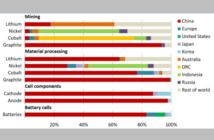
The report in Nature Communications that we link to below, provides hard evidence of the benefits of recycling lithium-ion batteries. To be more specific, Stanford University researchers confirm that recycling releases just 19% of greenhouse gases compared to mining. Other reasons for recycling lithium-ion batteries include an 88% saving in water, and an 89% reduction in energy consumption.
Materials Recovered By Recycling Lithium-Ion Batteries
Lithium-ion batteries contain six critical minerals, namely cobalt, copper, lithium, manganese, natural graphite, and nickel. We would not have batteries without them, although the search for cheaper, more abundant materials is ongoing.
Demand for these minerals is growing, but at different rates according to IdTechEx. This is partly the result of emerging alternatives for lithium-ion chemistry. The highest growth rate is in manganese and nickel, while copper and cobalt are experiencing slower growth.
Current Situation Regarding Lithium-Ion Battery Materials
Natural graphite remains by far the dominant material for lithium-ion battery anodes, although alternatives do exist. Emerging silicon anodes could change this picture in future.
Natural graphite currently experiences the greatest demand by weight, of the six critical lithium-ion minerals we mentioned above.
Lithium metal is an essential material in both lithium-ion battery cathodes, and anodes. This is one of the prime reasons for recycling these batteries, especially as they are so popular.
Copper demand for lithium-ion batteries is continuing to gradually fall, as battery scientists reduce the thickness of current collectors, and develop alternative composites.
Cobalt, nickel and manganese demand is heavily influenced by the emergence of lithium iron phosphate, and lithium manganese iron phosphate chemistries.
The main sources of these minerals are factory scrap, and end-of-life batteries. There are many compelling reasons for recycling lithium-ion battery cells, and we can confidently expect the industry to keep growing.
More Information
Redesigning Batteries For Recycling Easily
Recovering and Recycling EV Batteries