Researchers at University of Münster in Germany, have developed a novel approach to recycling dry processed cathodes in lithium-ion batteries. Their proactive method avoids using costly, sometimes toxic solvent evaporation. Instead, it encourages using polytetrafluoroethylene (PFTE) as a binder during manufacture. This adaption makes battery production more cost effective, and simplifies subsequent recycling.
Building Recycling Into Dry Processed Cathodes
The Münster team believes in incorporating recyclability into battery design. Their low-adhesion binder on the current collector, enables mechanical non-destructive recovery of the cathode composite, followed by re-granulation.
As a result, the active material, PFTE binder, and conductive carbon are all recovered in their original form. This means their electrochemical properties are intact, and they are immediately available for inclusion in new batteries.
Potential Recycling Benefits On the Horizon
Recycling lithium-ion batteries with dry processed cathodes in this way, could simplify recycling the mountain of spent electric vehicle batteries on the horizon. We also need to find a way to deal with large volumes of scrap material piling up from battery manufacturing.
This scrap arises during cathode and cell manufacture. It includes trimmings, process start-ups, and off-spec parts excluded due to quality deficiency, according to the research report we link to below. Current recovery methods can also be less environmentally friendly than the Münster proposal.
How Dry Processing L-Ion Cathodes Simplifies Recycling
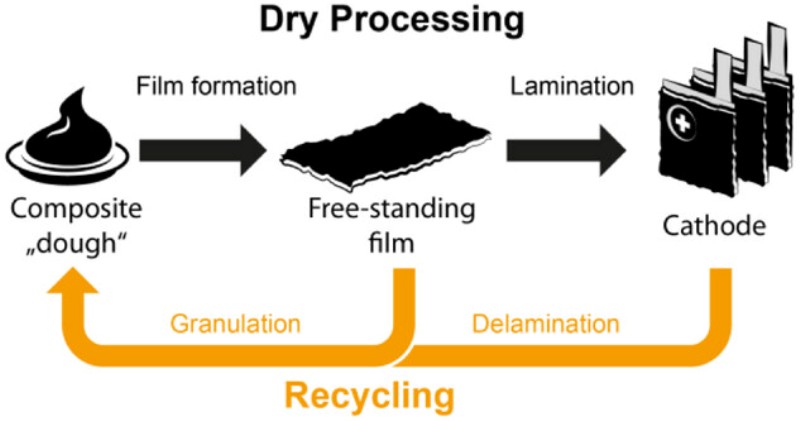
Dry processing lithium-ion battery cathodes during manufacture, is becoming state-of-art technology, according to the Munster report. This method eliminates the energy and cost-intensive drying process, including solvent evaporation and recovery.
The dry electrode material becomes a film which laminates onto the current collector. Hence, this only needs to be recovered after use, following the method proposed by the University of Münster researchers.
“Since the materials involved are not degraded by the recycling process, they can be directly reused,” a project team spokesperson explains. The Institute of Business Chemistry has confirmed their method is both sustainable, and cost-efficient too.
More Information
Dry Electrode Manufacturing Breakthrough
Dry Coating Battery Electrodes Advances
Preview Image: Recycling Spent Batteries and Scrap