Battery separators prevent electrodes touching each other and short circuiting. However, at the same time these separators must allow particular ions to pass through quickly. The hunt is on for a selectively permeable membrane separator that achieves both goals simultaneously. Researchers at Dalian Institute of Chemical Physics of Chinese Academy of Sciences, appear to have come close to this elusive goal.
A Polymeric Separator That’s Selectively Permeable
Polymeric materials are polymers comprising very large molecules, that link together in a chain. They are popular constituents of battery separators on account of their low cost, and scalable ability to maintain their properties regardless of size.
However, polymeric materials often have irregular and disordered pore structures, unlike inorganic nanoporous materials. This has made it difficult to separate molecules and ions efficiently. This deficiency has traditionally forced a compromise between permeability, and selectivity in terms of ions.
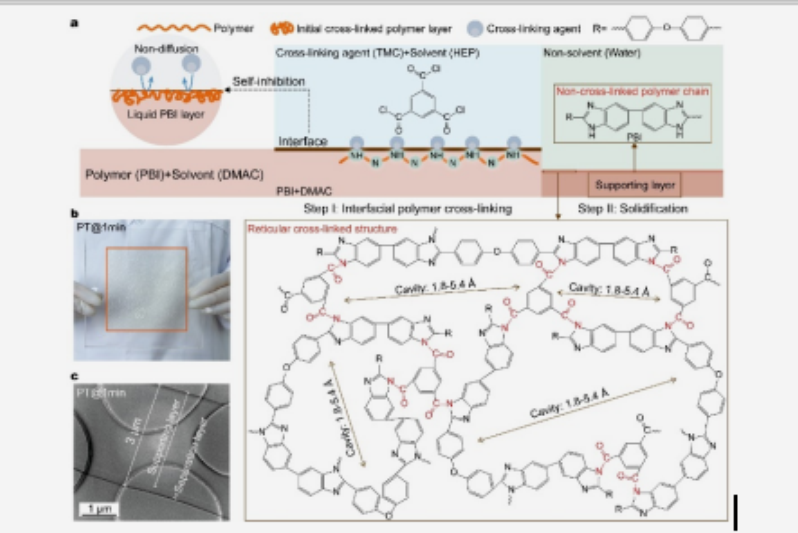
The Dalian Institute scientists in China appear to have cracked the code, by creating a new polymer cross-linking strategy. This has opened the door to ultra-thin polymeric membranes with nanoscale separation layers. We illustrate this principle in the image at the top of this article.
What the Separator Breakthrough at Dalian Institute Means
This breakthrough enables a selectively permeable membrane separator, that achieves both goals simultaneously. It had lead to a vanadium-flow battery with an energy efficiency of 82% at Dalian, which is a remarkable achievement.
“We have developed a simple strategy to reduce membrane thickness, Prof LI Xianfeng advises. “It significantly lowers ion-transport resistance, and addresses long-standing challenges in polymeric membrane design.
“It also provides significant insight for both membrane-based separation, and energy storage technologies,” the Prof adds. This achievement increases working current density and power density in aqueous flow batteries. It also resolves a long-standing challenge in polymeric membrane design.
More Information
More About Batteries and How They Work
Electrically Conducting Polymers Shuttle Fast
Preview Image: Membrane Fabrication Route and Structure