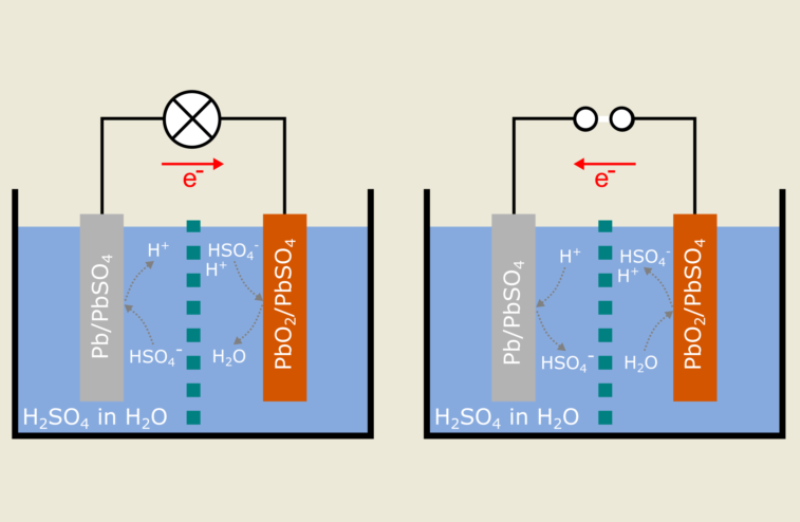
Lead acid batteries have a natural inclination to discharge their energy, by sending their ions from their negative to their positive plates. However, this potential only fully materializes when we connect their terminals through an external circuit. This article is about self-discharging in generator batteries of the lead-acid variety, which can catch us off guard.
Measures to Mitigate Self-Discharging in Lead-Acid Batteries
All batteries (including lead-acid ones) gradually discharge, even if they are not actually powering a device. This can happen surprisingly quickly depending on the circumstances, if we don’t do anything to manage it. Here are a few tips to remember:
Ambient Temperature Affects the Discharge Rate
A lead-acid battery at an ambient temperature of 30ºC, may self discharge at 5% a month. Whereas at a lower 20ºC, this could be closer to 3% monthly. Rates of self-discharging in generator batteries are likely to increase as the battery finally drains down.
How to Manage Lead-Acid Battery Self Discharge
Do Not Allow The Battery To Completely Discharge
Do not allow the battery to completely discharge. Doing so can cause weaker cells to discharge fully, and potentially reverse polarity. This can permanently damage the battery, and prevent it from recharging properly.
Disconnect the Lead-Acid Battery and Trickle Charge It
A battery can discharge at a high rate when connected to a device, including a generator, even if that device is turned off at the time. This phenomenon is largely due to a combination of parasitic loads, and natural self-discharge.
Parasitic load occurs because electronic devices, even when turned off, often have components like clocks, sensors, or standby circuits that draw a small and constant current. These parasitic loads can significantly drain a battery over time.
Over and above this, all batteries also self discharge naturally, due to a chemical process occurring inside them. To summarize at this point:
- Parasitic load from circuits that are always on, drain a battery for as long as their device (including a generator) is connected.
- We can stop parasitic load by disconnecting the device. But self discharge will continue, whether or not the battery is connected.
A battery drains at an accelerating rate when parasitic loads and self discharge occur at the same time. This combined load can drain a battery faster than 10% a month.
If we ignore this process, or forget it is happening, then the deep discharge that follows could potentially irreversibly damage the battery. The net result might be a significantly shorter lifespan, or a completely destroyed battery.
The Best Way to Counter Self-Discharging
While self-discharge in a battery is unavoidable, you can slow it down by disconnecting the battery from the generator when it’s not in use. To ensure optimal performance, keep the generator battery connected to a trickle charger when idle. This way, it will remain fully charged and ready whenever you need it.
More Information
Maintain Your Home Generator and Battery