Lithium-ion batteries dominate energy storage. Although with sodium-ion batteries ringing the bell at the door so persistently, we sometimes wonder for how long. The critical discriminator just has to be price. Clean Technica wonders when will battery prices fall, and by how much will this be. We add the rider: which batteries will be behind this shift?
How Do Sodium-Ion and Lithium-ion Batteries Compare?
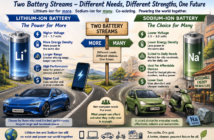
Sodium-ion and lithium-ion batteries work similarly, in that they shuttle their ions between their electrodes during charging and discharging. Sodium is abundant, cheap and widely available, whereas lithium is quite scarce and expensive.
Lithium-ion commands the market despite this, because it enjoys massive economies of scale. Whereas sodium-ion batteries ringing the bell quite insistently nowadays, have not even reached first base. Here’s a summary of how the two technologies shape up:
- Lithium-ion battery densities range from 150 to 300 watt-hours per kilogram. This makes them a good choice for electric vehicles and portable devices, where weight matters.
- Sodium-ion chemistry can only manage 100 to 160 watt-hours per kilogram currently. Although some of the following factors make them good contenders for stationery storage battery farms.
- Sodium-ion cycle life is steadily improving, and ranging between 500 and 1,000 cycles. It has a slightly lower cycling efficiency, although the technology is still developing.
- We have to mark lithium-ion chemistry down for its sensitivity to low temperatures, and instability at high temperatures. By comparison, sodium-ion batteries score better, and are not susceptible to lithium-ion’s thermal runaway either.
These factors appear to confirm that sodium-ion’s future lies in grid-scale energy storage, if and when it gets that far.
Which Path Will CATL Follow With Naxtra Batteries?
Chinese battery manufacturer CATL confirmed plans for its mass-produced Naxtra sodium-ion battery, on April 21, 2025. CATL claimed that this battery “breaks resource constraints and strengthens the foundation of the new energy industry”.
The CATL announcement contained details of two Naxtra variants. These are a passenger EV battery, and a heavy-duty truck stop-start battery. We did not find a reference to using the Naxtra for grid-scale energy storage anywhere. Do you think CATL could be hiding something up its sleeve?
More Information
CATL Super Fast Battery Challenges BYD
CATL Promises to Share Battery Technology