Our Milky Way is a vast accumulation of billions of stars and gas and dust that gravity keeps together. There is a supermassive black hole in the middle with a millions times greater gravity than our sun. Until quite recently, scientists thought this was the entire universe. Nowadays we know the Milky Way is a tiny glow in the endless light chain in the sky.
Not Quite an Endless Light Chain in the Sky

Scientists believe the universe must be finite, since the big bang caused it. Furthermore, Stephen Hawking thinks it will eventually collapse.
We do know that there are many other galaxies beside our Milky Way.
The Hubble Telescope identified 10,000 in the space of ten days. NASA thinks there could be as many as 100 billion galaxies in the universe. To put this in perspective there are 7.4 billion people alive on earth.
We Have a Vast Array of Colors, Shapes, and Sizes
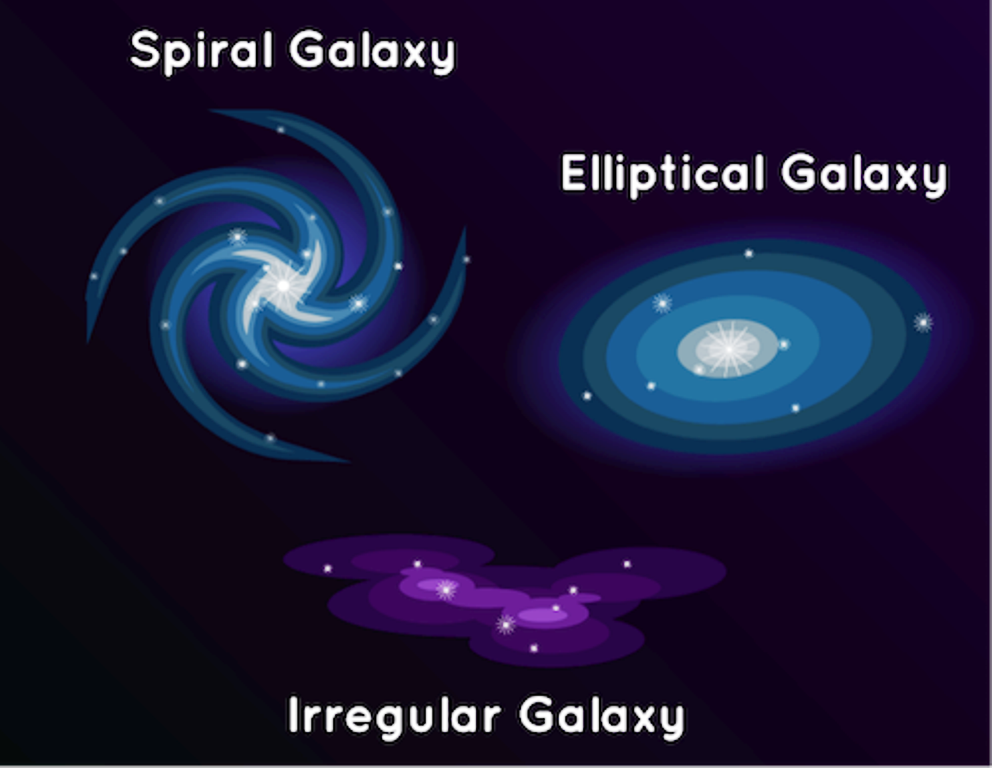
We cannot comprehend the almost infinite number of stars in our night sky. Even 100 billion galaxies is too large a number for us to imagine.
But that is not the end to the enormity. Each galaxy is a unique version of an irregular shape, an ellipse, or a spiral like our Milky Way.
The variety is remarkable every way we look at it.
Traffic Control in the Light Chain in the Sky
Gravity generally keeps things under control ‘up there’. However, accidents do happen and galaxies do get too close and collide. In five billion years from now, the Milky Way will bump into our nearest neighbor, Andromeda. Fortunately the suns and planets and solar systems are wide apart. There should be no actual impacts in the light chain in the sky.
Related