A flow battery is a special type of rechargeable battery that stores its energy. That said, it is different from familiar batteries such as lead-acid and lithium-ion. Sounds confusing? What is a flow battery really?
The Difference Between Flow and Conventional Batteries
- Conventional batteries hold their materials that store energy inside their cases. This means that everything happens in the electrodes.
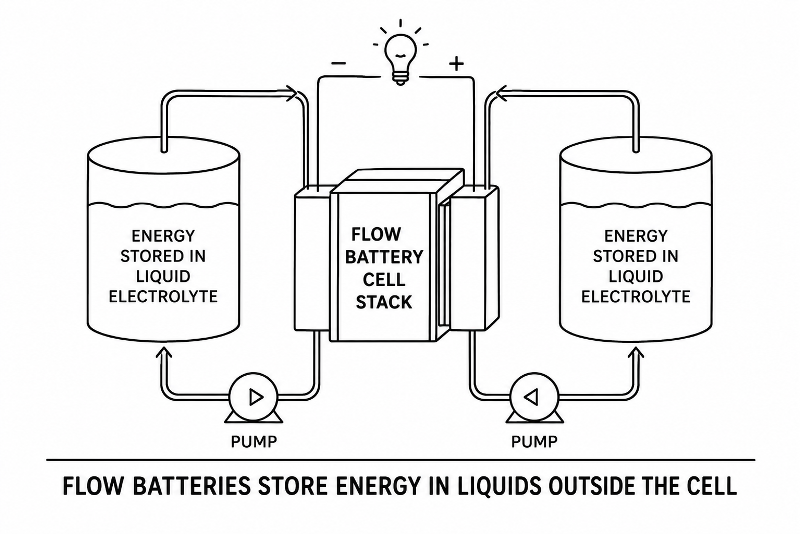
- Whereas, in a flow device, the energy is in the liquid electrolytes. These liquids are held in separate tanks outside the main battery cell.
How Flow Batteries Produce Electricity From This Arrangement
So much for, what is a flow battery really in headline terms. When we call on the device to produce electricity, pumps move the electrolytes from their tanks through the battery cell.
Chemical reactions occur Inside that cell. These reactions release electrons, creating an electric current that can power equipment. When we no longer need the electricity, the electrolytes return to their tanks.
Recharging Flow Chemistry When The Battery Is Flat
When we the recharge a flow battery we reverse the process. Electrical energy changes the electrolytes back to their original chemical state. They can then be used again to produce electricity.
This arrangement gives flow batteries an unusual feature. The amount of energy they store depends largely on the amount of electrolyte in the tanks.
We Can Easily Enlarge the Capacity Of Flow Tanks
Larger tanks can hold more electrolyte and therefore store more energy. The size of the battery cell, meanwhile, affects how much electricity the battery can deliver at one time.
This makes flow batteries particularly interesting for large energy storage systems. They can store electricity generated by sources such as solar panels and wind turbines. The stored energy can then be released when it is needed.
Does This Mean a Battery With a Liquid Storage System?
The basic idea is that simple. Store energy in liquids, move those liquids through a cell, and use chemical reactions to produce electricity.
More Information From Our Battery Blog