A flow battery may appear complex at first, but all its parts have straightforward jobs. So let us set any uncertainty aside, and ask this simple question. What is inside a flow battery?
What Are The Main Parts Of a Flow Battery?
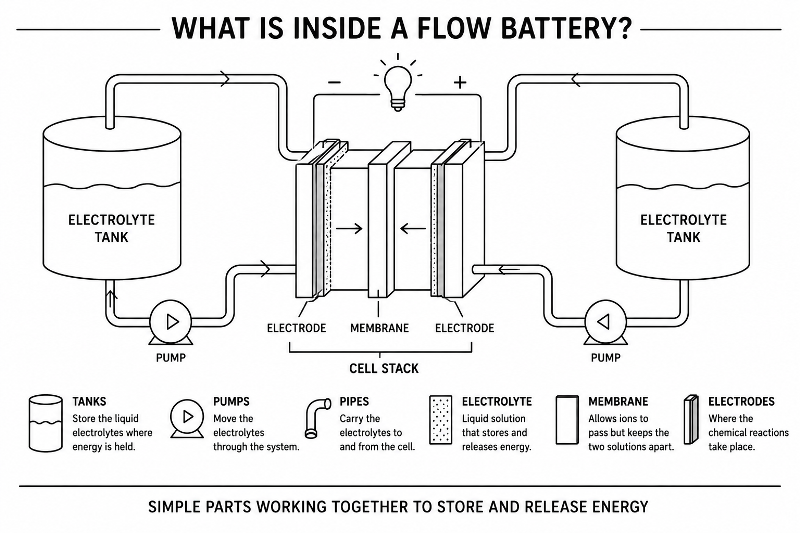
The most obvious parts are the two tanks. These hold the liquid electrolytes that store the battery’s chemical energy. Each tank normally contains a different electrolyte, though.
- Electric pumps move the electrolytes from the storage tanks through the battery cell, and then return them to the tanks.
- Pipes connect the tanks, pumps and cell. They provide the routes through which the electrolytes circulate.
The Cell, The Heart Of The Battery Producing Electricity
At the centre of the system lies the battery cell, where electricity is produced. The cell contains two electrodes. These are usually called the positive and negative electrodes.
Chemical reactions take place at the electrodes when the electrolytes pass through the cell.
These reactions cause electrons to flow through an external electrical circuit. The flow of electrons is the electricity produced by the battery.
The Cell Membrane Acts As Gate Keeper Admitting Ions
A special membrane manages between the two sides of the cell. It allows certain ions to pass, while keeping the two electrolytes separate.
This membrane is important because the battery needs ions to move inside the cell. At the same time, the two electrolytes may not mix.
In Summary This How The Battery Parts Work Together
To summarise, there are therefore several parts inside a flow battery.
- Electrodes provide the surfaces where chemical reactions occur.
- The membrane controls the movement of ions between the two sides.
- The electrolytes carry the chemicals that store and release energy.
Together, these parts turn chemical energy in liquids into electrical energy.
Key Difference Making These a Class Of Their Own
The key difference between flow batteries and conventional batteries is much of the battery’s energy is stored outside it, in the electrolyte tanks.
More Information From Our Battery Blog