

A telegraph is a device for transmitting and receiving messages over long distances; it has two main components: a sender and a receiver. It works on basic principles of electricity and electromagnetism. It is possible to construct our own simple telegraph at home. Though the simple telegraph could not be used for long-distance communication, it can demonstrate how a telegraph works.
Material Used:
9 Volt Battery
Copper Wire
Screws
Nail
Wooden Plank
Thin copper plate

Source: http://www.experiland.com/_images_diagrams/ProjectDrawing_P38.jpg
Process:
Construct a sender:
Take a wooden plank and cut out a thin strip of bendable copper.
Tilt the thin strip of copper upwards and screw it into the wooden plank.
Put a screw underneath the tilted end of the copper strip, in such a manner that it would be touched by the copper strip, if the strip is bent downwards. Connect this screw with the negative terminal of the battery.
Construct a receiver:
Take two wooden planks to make L shape structure out of them.
Take a nail, and coil the six foot long copper wire around the nail about 100 times. Leave about six inches of free wire extending from each end of the nail. This is how an electromagnet is made.
Drive the nail into one side of the wooden plank, such that it remains steady on the plank.
The nail should be little bit lower than the vertical wooden plank. Cut out another strip of copper and place it on the vertical wooden plank, in such a manner that it hangs over the nail.
The end of the wire from the lower end of the nail should be connected to the positive terminal of the battery, while the wire from the upper end of the nail should be connected to the sender.
Function:
Once your electronic telegraph is ready by following above mentioned steps, you can start sending messages.
First of all, you need to press the sender copper strip, so it will touch the screw. This will complete the circuit of the device, and direct the current through the coiling wire. An electric coiling wire is magnetic, and so it will attract the receiver’s copper plate, making a “click” sound.
When the sender’s copper strip is released, the circuit is broken, and the magnet stops working. The receiver’s copper strip will then bounce back up, making a “clack” sound.
You can now start sending messages using the Morse code mentioned below. A dot (.) is a quick press-then-release (click-clack) and a dash (-) is a press-wait-release (click-pause-clack).
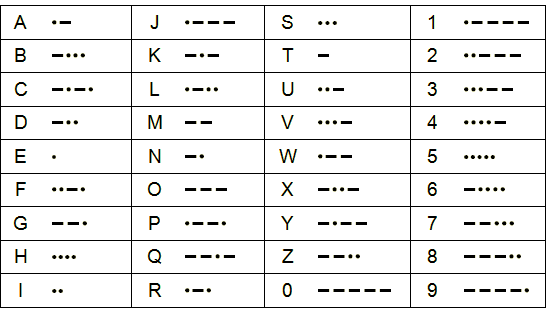
Source: http://www.bbc.co.uk/schools/gcsebitesize/science/images/gatewaysci_09.gif
Related posts:



1 Comment
1/21/2020
Ok. I am attempting to make this. I have a few questions.
1. Where do I buy flat pieces of copper ?
2. Must the screws be copper or can I use a different material screw ?