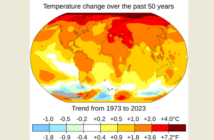
In 2018, the Earth experienced the 4th warmest year on record. Over the last several years, the planet has been steadily increasing in temperature, with 2016 being the Earth’s warmest recorded year, as well as 2015 and 2017, according to information by NASA, the NOAA, and the U.K. Met Office.
What This Indicates:
Yearly rankings, while helpful in hinting to emissions impacts, aren’t entirely indicative of long-term climate change. Natural variability can sway years up or down in temperature rankings, but the overall picture is looking worse with each year. Since 2005, the Earth has experienced nine of the ten warmest recorded years on the planet.
Greenhouse gases due to the burning of fossil fuels as well as deforestation and intense agriculture have increased at alarming rates, which have not been seen in over 800,000 years.
In April, the Arctic sea ice extent reached a record low. This is followed by news that carbon dioxide levels in the atmosphere reached 415 parts per million for the very first time in human history – becoming the highest level on record seen in three million years.
The Numbers:
According the NOAA, in 2018, the average temperature across global land and ocean surfaces was 1.42 Fahrenheit, which is above the 20th century average.
According to NASA’s Goddard Institute for Space Studies (GISS), global temperatures in 2018 were 1.5 degree Fahrenheit warmer than in the 1951-1980 average.
The World Meteorological Organization and the U.K. Met Office ranked 2018 one of the top warmest years on record.
According to the NOAA, the annual global land and ocean temperatures has increased by an average rate of 0.13 degrees Fahrenheit per decade since 1880. This rate has more than doubled since 1981.
Where Do We Experience These Numbers?
Long term global warming is being felt almost daily around the world. Floods, heat waves, precipitation, and overall ecosystem changes are dead giveaways of global warming.
In the Arctic, temperatures have increased more than twice the rate of the world, which leads to a loss of land and glaciers melting. Since the 1880s, the world’s surface temperature has increased about 2 degree Fahrenheit, which the vast majority of scientists attribute to increased greenhouse gas emissions due to human activity.
Paris Agreement:
The world’s average surface temperatures are going closer to the 1.5 degree Celsius target contained in the Paris climate agreement. This is crucial to many low-lying island nations because their survival is dependent upon landmass, but as the world continues to warm and sea levels rise, there are almost immediate threats to human and animal habitat.
According to the Global Carbon Project and the International Energy Agency, in 2018, global carbon dioxide emissions from the burning of fossil fuels like oil, natural gas and coal continued to rise to the highest levels in recorded history.
To meet the Paris Treaty Agreements goal of 1.5 degree Celsius, global greenhouse gas emissions have to fall by 45 per cent by 2030 and reach a “net zero” by the mid-century.
Related: