The Australian Commonwealth Scientific and Industrial Research Organization (CSIRO) published a report on October 7, 2020 that caused a stir. In headline terms, it said the coronavirus could survive on banknotes, brushed stainless steel, glass, vinyl and cotton cloth for as long as 28 days. We dedicate this post to unpicking the COVID-19 virus survival rate, because there is more to it than that.
Notable Facts When Unpicking the COVID-19 Virus Survival Rate
The CSIRO researchers wanted to establish the outer limits of coronavirus transmission via materials. They knew UV light can kill the virus, and so they conducted their experiments in the dark. First, they suspended living viruses in a laboratory liquid matrix. Then they applied this infectious compound to several common surface types.
They observed the survival rates of the infectious virus in the liquid matrix at several different ambient temperatures. These were 68 ºF (20 C), 86 ºF (30 C), and 104 ºF (40 C). This is what they found when unpicking the COVID-19 virus survival rate under those conditions.
The Ambient Temperature Was a Determining Factor in Virus Survival
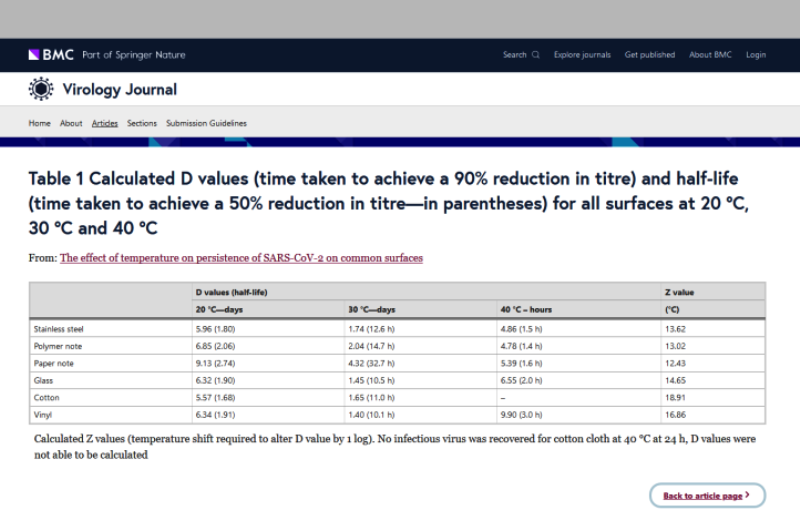
These are the headline findings in the table in the preview image from Virology Journal:
1… Half-lives were between 1.7 and 2.7 days at 68 ºF (20 C)
2… This reduced to a few hours at temperatures of 104 ºF (40 C)
However, when they exposed viral loads equivalent to the highest concentration excreted by infectious patients at 68 ºF (20 C), the virus remained viable for up to 28 days. Equally interestingly, it survived for less than 24 h at 104 ºF (40 C) on some surfaces.
The CSIRO researchers agree airborne transmission is by far the major route for coronavirus spread. However, it can survive for longer than we thought at average room temperature and humidity comfortable for humans.
Related
How Long a Covid Virus Survives on Surfaces
Guide to Sanitizing Computers and Peripherals
Preview Image: Table of Main Findings