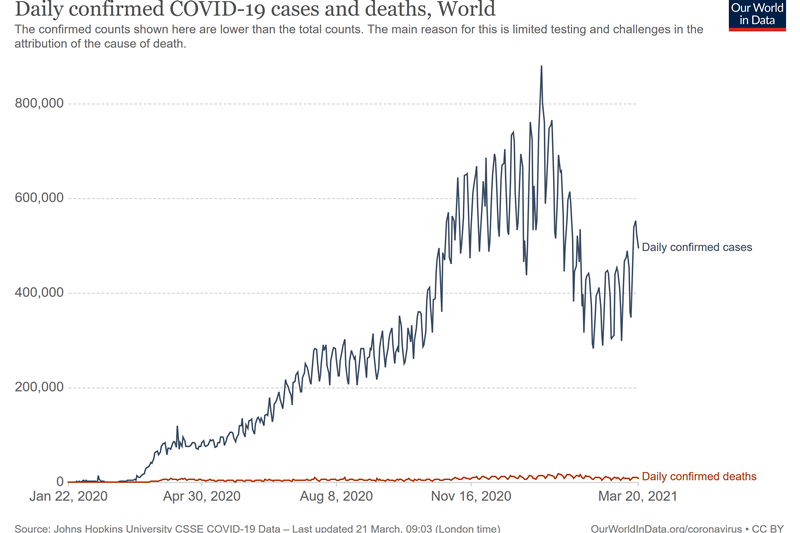
In tough times hope rises in our hearts, but it can be cruel on the back spin. On 21 March 2021 Nature.Com asked has COVID peaked? It says perhaps, because global COVID-19 cases have fallen significantly since early January 2021. Could this be the beginning of the end of the pandemic it wonders? But the variants are a concern.
The Early Evidence Is Encouraging, However …
Caitlin Rivers is an epidemiologist at Johns Hopkins University in Baltimore, Maryland. She sees the early evidence as encouraging. However, there are still many places where population herd immunity and vaccine coverage are quite low, and those places will remain vulnerable.
We know the numbers have improved significantly since January 11, 2021, when there were 740,000 new cases of COVID-19. And there were 14,400 deaths two weeks later in a single day. But by February 20th, the numbers were down to 360,000 and 9,500 respectively. Hence the question has COVID peaked?
Opinions are divided on the medium term implications. Ramanan Laxminarayanisan is an epidemiologist at Princeton University, but based in New Delhi, India. He agrees more waves could follow, but ‘the worst is behind us,’ he argues.
Several Reasons Why COVID May Have Peaked
We know that in theory at least the world will eventually achieve ‘species immunity’ with over 70% of us with natural antibodies. Vaccines are working in countries like UK and Israel that have high coverage. Lock downs and other restrictions are also helping. Perhaps these factors will combine to our advantage?
Sebastian Funk is an epidemiologist at the London School of Hygiene & Tropical Medicine. He is convinced we are ‘in a race against time’ because we are still at risk from a wave of a new variant. ‘Can we vaccinate people fast enough so we can avoid a future peak,’ wonders Rachel Baker, another epidemiologist at Princeton University in New Jersey …
Related
Vaccines Can’t Stop Next European Surge
Iceland is Open for Business Despite COVID
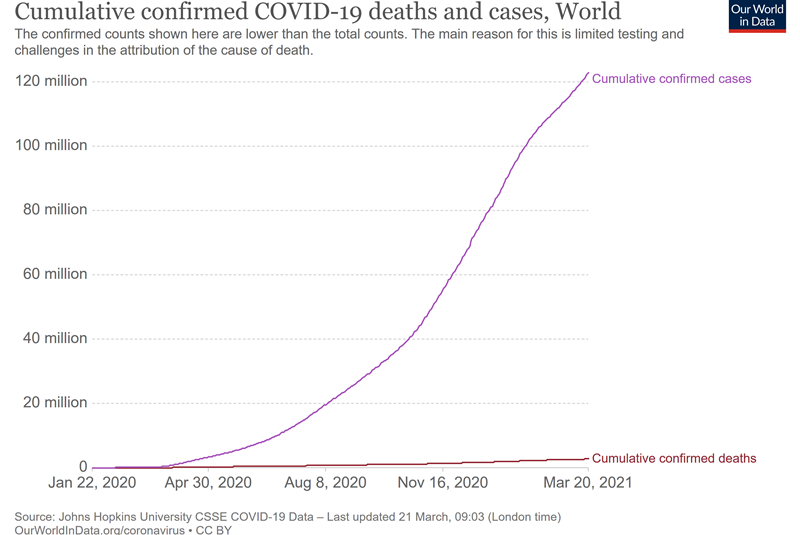
Preview Image: Daily Cumulative Death Rates