It’s a long shot observed William Heseltine, writing for Science American. He is a former Harvard Medical School professor, and founder of the university’s cancer and HIV/AIDS research departments. But we do know that is what happened after the 1918 virus killed fifty million people and then faded. Therefore, it’s tempting to ponder could the COVID virus become less lethal as our vaccines take effect. Let’s review what we do know.
Viruses Exist to Adapt and Thrive Despite Their Environment
William Heseltine says viruses exist to thrive, and to do so they must adapt to their environment, and learn to counter human defenses. Scientists had initially thought the COVID virus would be stable because of onboard ‘error proofing’.
However, last summer a Texas researcher noted a COVID variant with a changed spike protein was becoming dominant. Since then, multiple new variants became more transmissible, more lethal and more able to evade our immune defenses.
The influenza virus is from the same coronavirus stable, and it certainly seems to keep ahead of human counter strategies. The SARS-Cov-2 virus has also shown ability to make abrupt, and substantial antigenic shifts, in addition to drifting to new variants.
Could the COVID Virus Become More Lethal, Not Less?
The most radical shifts occur when a virus jumps to a different species, including from animal to human. This is how the 1918 virus, SARS, MERS, and COVID broke out into humans. Hence, there is some substance to the theory COVID could become less lethal as the 1918 virus did.
However, and it’s a big ‘however’ William Heseltine warns the COVID virus would still return, potentially for years thereafter. And it could reappear in a more lethal form without warning.
We must therefore nurture the resources we have available to counter the next threat, because it will come although we know not when. Effective vaccines and mass immunity may suppress a virus, but there’s no reason to believe they could eliminate it entirely.
Related
Delta Plus Variant With Noteworthy Difference
Wider World Struggles as COVID-19 Surges
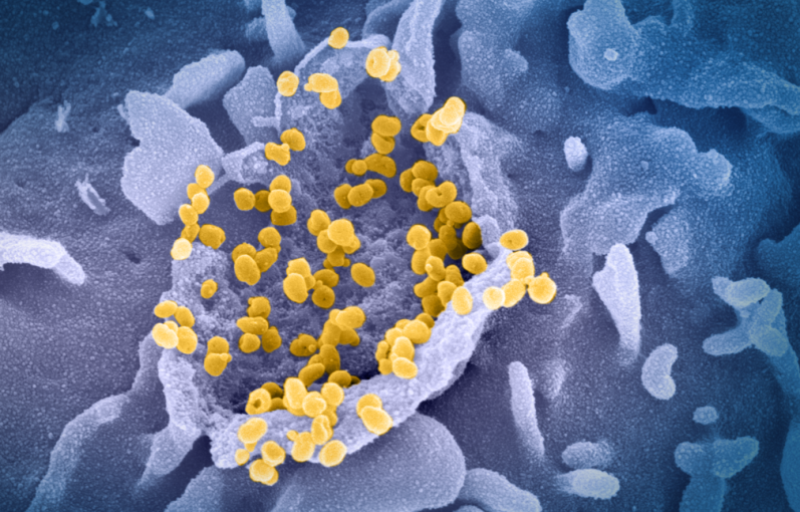
Preview Image: New SARS-CoV-2 Particles Emerging