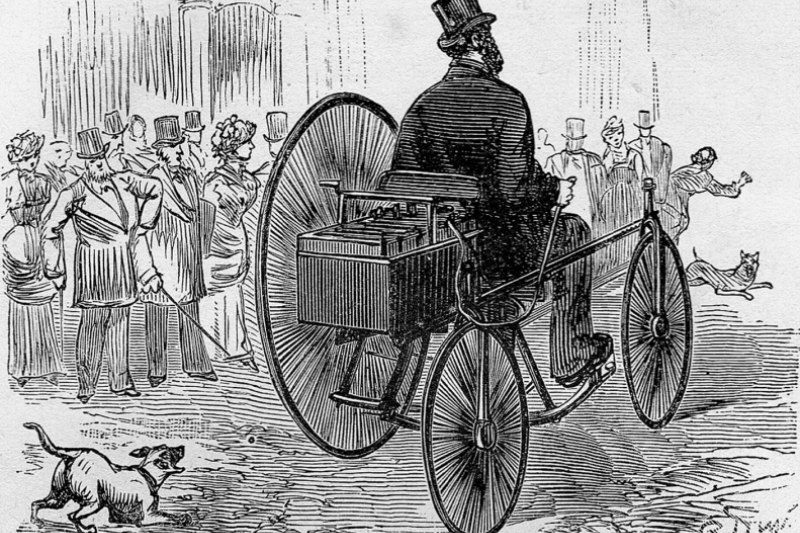
It’s perfectly reasonable to assume Tesla’s 2004 roadster was the first of its kind. However, nothing could be further from the truth. That’s because Parisian inventor Gustave Trouvé was already entertaining pedestrians with his electric tricycle in 1880. But was his really the very first practical electrical auto?
It Depends What You Mean by Electric Vehicle
A vehicle is ‘a machine that transports people or cargo’ according to Wikipedia. Hence early scaled-down models by Hungarian Ányos Jedlik, Scot Robert Anderson, and Hollander Stratingh don’t fit the bill. Neither does Vermont blacksmith Thomas Davenport’s contraption which operated on a short, circular, electrified track.
However, Scot Davidson’s electric loco that hauled 6 tons of cargo 1.5 miles at 4 mph probably was the first practical electric vehicle. It may have used zinc-acid batteries. But was not an electric auto by our definition, because it could not spontaneously travel in any direction.
The very first practical electrical auto really only became possible after Camille Faure developed his commercial lead acid battery in 1881. Parisian Gustave Trouvé seized the opportunity and electrified a three-wheeler.
How the Very First Practical Electrical Auto Worked
Gustave Trouvé was an innovative clock-maker-cum-electrical engineer. In 1880, he improved the efficiency of a Siemens electric motor, and fitted it to a James Starley tricycle from England. He successfully tested his creation along the Rue Valois in central Paris on April 19, 1881. But he apparently could not patent it, because he simply cobbled other ideas together.
However, our gallant Parisian was not disheartened. He adapted his battery-power motor for marine propulsion and fitted it to a boat inventing the outboard motor in the process. He received the prestigious French Légion d’Honneur award for his inventions the following year. Gustave Trouvé was an imaginative clock maker by all accounts!
Breaking News
Might We Afford a Network of Electric Roads?