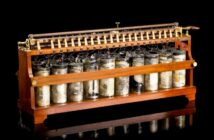
There were no qualified structural engineers when Greeks and Romans built their magnificent buildings. Likewise, there were no licensed electricians in the days of Leyden Cell capacitors either. Early researchers were more likely to be theologians or philosophers. Johann Heinrich Winckler connected Leyden Cells and wrote scripts for Bach cantatas, merging scientific and creative thought.
We Found Johann Heinrich Winckler Almost By Accident
We were engaged in our search to find out on who first joined Leyden Jar capacitors together to create more powerful ‘batteries’. Daniel Gralath certainly had his fans, and then our eyes fell on a lesser-known individual who may also have the claim to fame.
Institute of Electrical and Electronic Engineers quotes the following from an 1884 manuscript by one E. Hoppe. “On July 28, 1746, Winckler placed three large jars filled with water, each with a wire inside, in the Pleisse River. He surrounded the outer coverings with a chain which ended in a button on the nearby river bank.
“He attached the inner wires to the conductor of the electric machine, and after this, broke the connection. There was so violent a blast when the bottles discharged, that the resulting spark was visible 200 paces away on a bright day, and heard even further.” This suggests Johann Heinrich Winckler as a definite contender for the award.
But There Was More to Winckler Than Just That
Wikipedia reveals there was more yet to the German-born physicist and philosopher. He was a famous electrical investigator, and became a member of the British Royal Society in 1747. He gained fame during an illustrious career for his “showcersuche” machine, which produced “large sparks and electrical charges”.
However, Bach Cantatas Website reveals yet another side to Johann Heinrich Winckler. He wrote texts for Johann Christian Bach’s cantatas. He also believed animals have “intelligent and sensitive souls”. He was ahead of his time when it came to animal rights, and therefore a thought leader of his time.

More Information
Did Daniel Gralath Invent Linked Capacitors
Abbé Nollet Shocks Humans with Capacitors