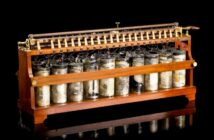
Electricity was a new science in the middle-eighteenth century. Nobody had experienced a bad electric shock yet, most likely because the charges in Leyden Jar capacitors were too weak. This left the door wide open for Abbé Nollet to conduct human trials with these primitive ‘batteries’. This is definitely not a candidate for a school experiment!
Nowadays we understand that those simple electrical devices met the criteria for being early capacitors. Hack-a-Day explains how the liquid in the glass jar fulfilled the role of one plate. While the glass was the dielectric separating it from the second plate, which was the experimenter’s hand.
Who Was Abbé Nollet Why Else Is He Famous?
Jean-Antoine Nollet was a clergyman (they called them ‘abbés’) who studied humanities and had a master’s degree in theology. He became head of an abbey where communities of monks gathered. However, it was not long before the fascinating science of electricity distracted him.
Abbé Nollet became famous, and was a leader among early French scientists. He proposed a theory that electricity flowed continuously between charged bodies. This held sway until Franklin proposed the idea of two qualitatively different opposing forces. His most enduring memory is calling the first capacitors ‘Leyden Jars’.
Jean-Antoine Nollet Was Electricity’s Original Showman
The abbé was a showman-cum-scientist. That’s clear enough from the image accompanying this post. Wikipedia confirms how he assembled two hundred monks in a circle of one mile circumference.
He connected them with pieces of ‘iron wire’ through which he discharged a ‘battery’ of Leyden Cells. The monks all reacted at approximately the same time, demonstrating the speed at which the electricity travelled.
Spark Museum confirms that Abbé Nollet repeated the trial with 180 soldiers holding hands. But this time he staged his trial before King Louis XV of France at his Versailles Palace. The soldiers all jumped at the same time, as the electricity passed through their bodies. In those days we don’t suppose they were volunteers.
More Information
Was van Musschenbroek Capacitor the First?