Henri Tudor founded his Tudor Battery brand in 1890, to manufacture and sell lead-acid batteries throughout Europe. Although he later changed the name to “Franco-Belgian Anonymous Society for the Manufacture of the Tudor Accumulator” in order to attract investors. By then there were already 1,200 Tudor batteries in service in many countries. The company prospered in several forms through to 1994, when it became part of Exide.
Lohner-Porsche Chooses Tudor Batteries for C.2 Phaetons
Our story continues in the workshop of Ludwig Lohner, a late 18th century Austrian carriage-maker. He traveled through Europe and United States, and returned convinced the horse and carriage era was over. Lohner began experimenting with automobiles instead, and decided to focus on electric vehicles using his Tudor batteries in 1898.
The carriage maker formed an association with the Vereinigte Electricitäts company. They designed and built their model C.2 Phaeton, incorporating an electric drive-train designed by Ferdinand Porsche. Porsche entered one of four C.2 vehicles they produced in the 1899 Berlin road race, where it won the gold medal:
- The Egger-Lohner C.2 Phaeton finished 18 minutes ahead of the second car.
- The judges rated it highest for efficiency, because it used least energy in urban traffic.
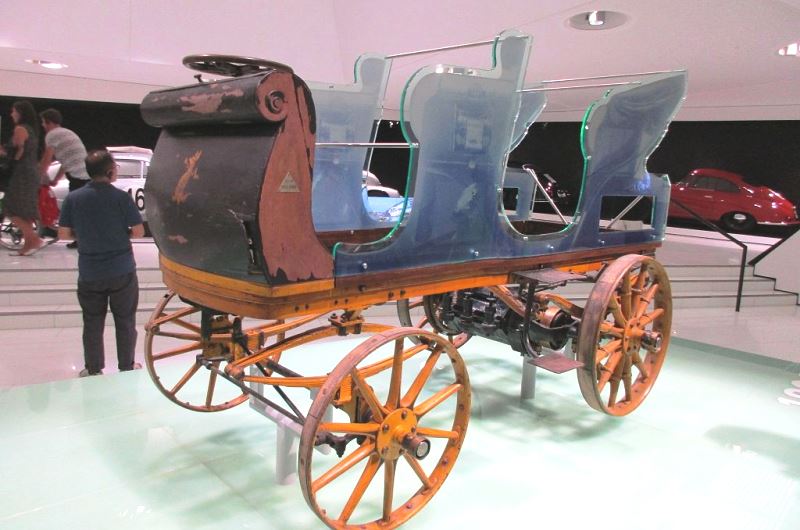
Stripped Down Remnant of the Egger-Lohner C.2 Phaeton

The winning gold medal C.2 Phaeton changed hands several times during the century that followed, losing most of its body in the process, and its Tudor battery. However, that said, its performance was impressive back then:
- The electric motor delivered 3 horse-power at 350 revs per minute.
- Bursts of 5 horse-power / 22 miles-per-hour were possible after overcharging.
- Total driving range between recharging was 49 miles in 3 to 5 hours.
The battery contributed 36% to the overall weight of the 3,000-pound vehicle. The wheels were also wood, although they did benefit from cutting-edge pneumatic tires. The vehicle was available in an open-air or coupe version, depending on the owner’s choice.
Battery energy reached the drive wheels through a 12-speed controller, with six forward gears, two reverse ones, and four to stop the car. The chassis was mainly wood, although most of that material vanished down the years too.

More Information
Dr Ferdinand Porsche Builds Electric Car