

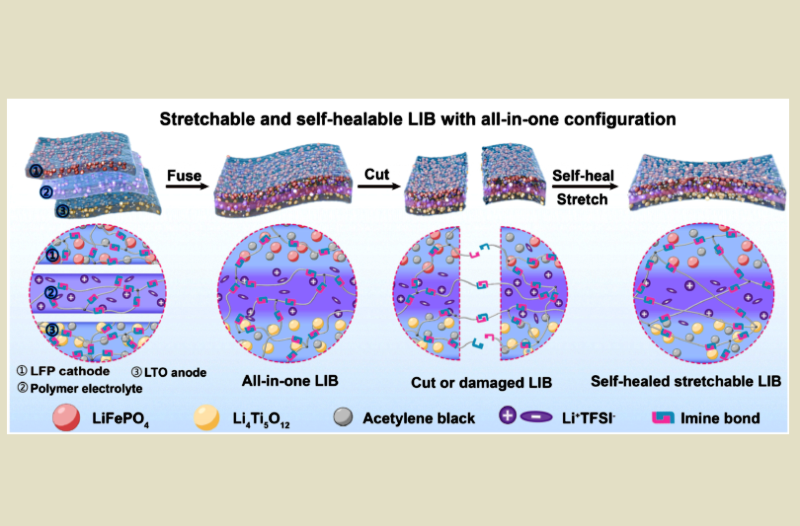
Scientists at State Key Laboratory of Supramolecular Structure and Materials, College of Chemistry, China, have achieved a significant breakthrough. They have found a way to build a stretchable self-healing lithium-ion battery, despite the inherently unstable nature of the material. We append a link to their research report, which makes for most interesting reading.
Why Stretchable Self-Healing Lithium-Ion Batteries Now?
Conventional, rigid lithium-ion batteries are unable to withstand the stresses and strains of flexible environments. That’s because regular deformation can cause them to be damaged by accidental external stimuli, or sharp objects. These factors exclude the chemistry from flexible applications.
The preamble to the main research report therefore regards flexible lithium-ion batteries as ‘highly desirable’. This is because a self-healing version could ‘prolong their life-time and enhance their reliability’ too. Previous attempts by others were merely stretchable, and were unable to self-repair.
However, as Technology Today reports, the improved version from State Key Laboratory in China overcomes these shortcomings. Their stretchable self-healing lithium-ion battery ‘steadily provides power even after being stretched and subsequently healed’, which is great news for a number of applications.
An Exciting Breakthrough for Wearables and Medical Devices
The research report explains how the team designed ‘a class of dynamic covalent polymers, cross-linked by dynamic imine bonds’. Then they used this combination as a polymer electrolyte, but also as the ‘binder of electrodes’. This blend gave their battery the flexible characteristics they desired.
“Our achievement lies in the construction of a lithium-ion battery with all-in-one configuration,” the report explains. “Wherein the electrolyte and electrodes can be fused together at the interface, through the exchange of the dynamic imine bonds in both the electrolyte and electrodes.
“Such a design not only endows the battery with both stretchability and self-healing capability, but also overcomes the de-lamination problem of the lithium-ion battery upon stretching. This is a novel and viable strategy for the design of stretchable and self-healable energy storage devices.”
More Information
Flexible Zinc-Ion Batteries in Progress
Flexible Batteries in Personal Devices


