Argonne National Laboratory has announced a novel lithium-air battery, with potentially four times the density of lithium-ion. The US Office of Science at the Department of Energy explains how the innovative lithium-air battery uses a solid composite electrolyte, based on nanoparticles that contain lithium.
The Innovative Electrolyte in the Lithium-Air Battery
The nanoparticle electrolyte embeds in a matrix of special ceramic-polyethylene oxide polymer, making it a solid-state battery. However, this particular battery achieves a four-electron reaction. This is double typical lithium-ion battery performance.
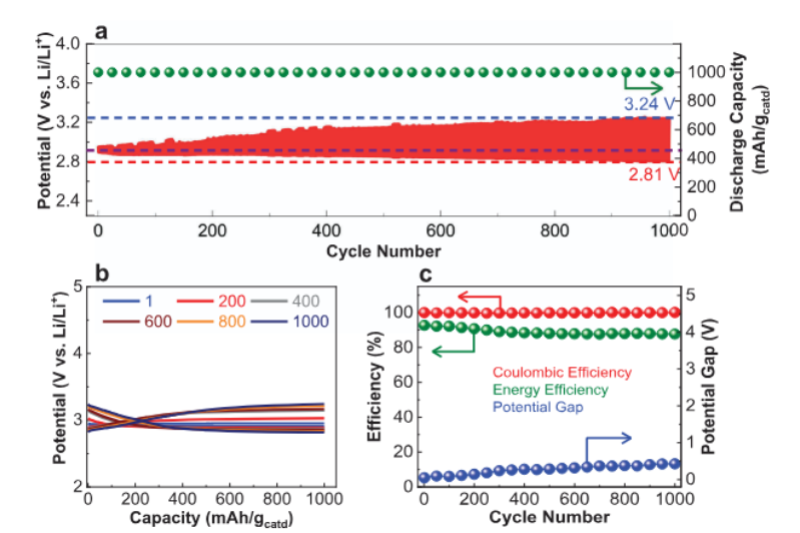
We googled “four-electron chemical reaction battery”. We learned the improved redox reaction delivers greater energy density, and potentially longer cycle life too. Indeed, the report suggests the battery could charge / discharge 1,000 times, and achieve 1,200 watt-hour density per kilogram.
As we thought about it, we realized this innovative lithium-air battery could dramatically increase the capacity of battery storage. And furthermore, being solid state, should hugely reduce concerns over the possibility of this lithium battery burning. We also noted that all this was possible at room temperature too.
What This Means for Battery Science in Future
Our industry has been dreaming as long as we can remember, of batteries that compete with gasoline energy density. A battery such as Argonne National Laboratory has developed, could beat carbon fuels hands down, in terms of driving range.
Moreover. an air battery with 1,200 watt-hour density per kilogram, could revolutionize battery energy storage, while also bringing cost down. We may be standing at the threshold of a new generation of batteries that, for the first time, are up to meeting the demands of a truly green economy.
More Information
More Density with New Lithium-Air Battery
Solid State Battery Technology Potential
Preview Image: Innovative Lithium-Air Battery