Volkswagen uses nickel manganese cobalt batteries for its current range of electric cars. These batteries have better driving ranges than lithium phosphate batteries, although they do cost more. Keep reading, if you would like to know all about Volkswagen’s EV batteries, or at least the fundamentals. We acknowledge input from Volkswagen’s SEAT subsidiary in this regard.
Volkswagen’s Nickel Manganese Cobalt Batteries
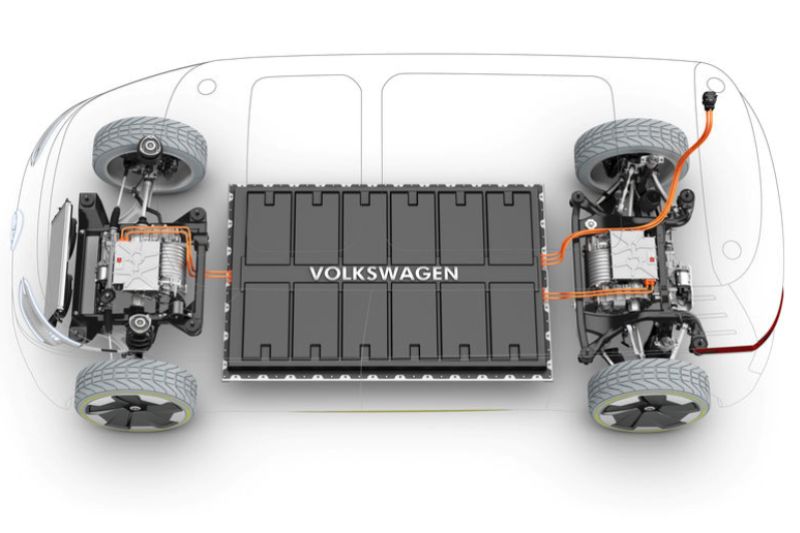
Volkswagen’s nickel manganese cobalt battery cells, group into modules for assembly into packs. These packs form the complete battery, together with control electronics, and the cooling system inside the casing.
The motor manufacturer’s batteries all adhere to this principle, regardless of whether they are for all-electric, or hybrid vehicles. A typical all-electric Volkswagen battery has 300 cells, so it can travel further on battery power than a VW hybrid with 100 cells.

How Long Should a Volkswagen EV Battery Last?
When we wanted to know more about Volkswagen’s EV batteries, we found the SEAT subsidiary’s article to the point. “It depends on how people drive their car,” it states. “Although the frequency of use, the temperatures the batteries are exposed to, and the number of charge / discharge cycles also play a role.
“In the case of our vehicles, we can ensure a minimum of 100,000 miles, or 8 years of guaranteed service life, thanks to the intensive tests we subject our batteries to.” We understand that those trials include extreme climatic conditions, and ‘modes of use that push batteries to their limits’.
However, the SEAT article continues, a Volkswagen battery should theoretically still retain 80% of its energy capacity when the warranty expires. In practical terms, the user may experience a 20% shrinkage in driving range per charge, and acceleration. This trend is typical of almost all electric vehicles.
More Information
Volkswagen Semi-Solid Flowable Battery
Electric Car Battery Life Revealed