Lithium-ion batteries (li-ion) are at the core of virtually every electric vehicle, laptop and smartphone, despite occasional fires. They also play a vital role in utility electricity storage. We are reaching the stage where the world cannot extract lithium fast enough. We were excited when we came across a report in Interesting Engineering concerning restored li-ion cathodes, with 76% capacity compared to new electrodes. This could open the door wider to repurposing used batteries.
Restoring Li-Ion Cathode Capacity
Battery makers are unsure about using recycled or repurposed cathode materials. This is because they are concerned these might deliver unreliable performance. And as result we have a growing pile of used lithium-ion batteries, that are a challenge to recycle economically.
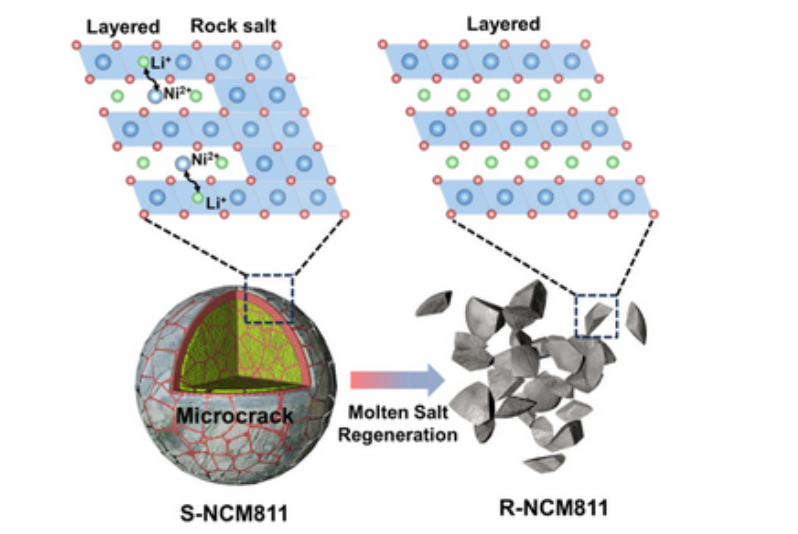
But a lateral-thinking approach could change this paradigm, given a report on the Joule platform we link to below, and a post by Noticias Ambientales. This news channel confirms how a team at Huazhong University of Science and Technology achieved a breakthrough, by restoring li-ion cathodes to 76% capacity.
Cathodes play a critical role in storing and releasing energy in batteries. They accept electrons from an external circuit during charging, and they pass them on to the anode during discharging. The break though was as simple as repairing used cathodes by soaking them in a bath of molten salts.
How the Molten Salt Regenerates Cathodes
The molten salt literally heals the scars of gradual degradation, lithium loss, and a rock salt phase that forms on the battery cathode surface. This phase has previously complicated recycling, according the report we link to on Joule below.
The technique also avoids the use of destructive hydro-metallurgical recycling, which recovers the original material, but destroys the cathode structure. The Huazhong University method restores both cathode structure and performance.
The scientists conclude, “These restored li-ion cathodes with 76% capacity provide a feasible path for the green regeneration of high-nickel ternary materials. Our method supports the development of closed-loop recycling for high-performance batteries.”
More Information
Recycling Dry Processed Cathodes For L-Ion
Anodes and Cathodes and Their Roles