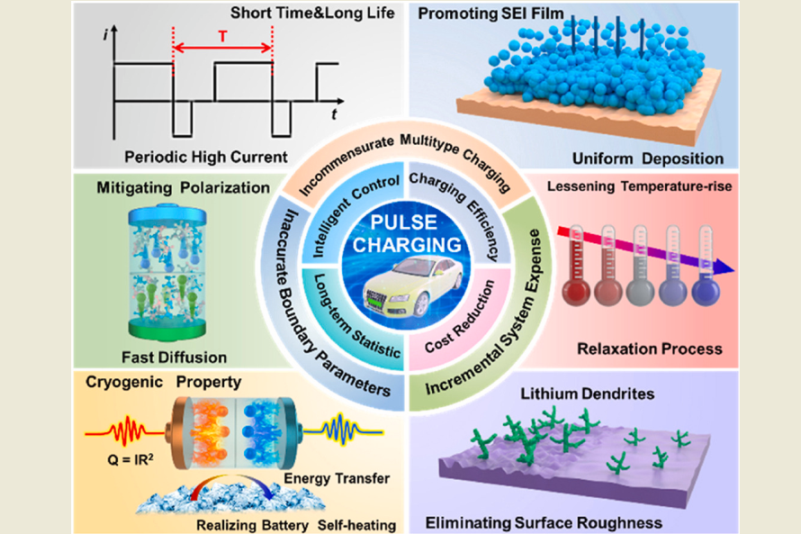
Researchers at Chalmers University of Technology in Gothenburg, Sweden, report a positive relationship between pulse charging and battery life. We investigate what pulse charging is, its pros and cons, and what this new discovery could do to improve energy storage generally.
How Pulse Charging Works in Batteries
Pulse charging feeds electricity into a battery in short bursts, instead of a smooth continuous flow. Brief pauses between pulses allow the battery to recover, and chemical reactions a chance to settle and absorb the energy evenly.
There’s a possibility that a positive relationship exists between pulse charging and battery life too. That’s because the technology causes less heat, and could prevent rogue deposits accumulating on battery electrodes.
How This Could Improve Battery Life
Battery scientists at Chalmers University noted how rapid-charging batteries contributed to shorter battery life, due to reduced durability. They decided to investigate whether pulse charging might allow high charge rates, but without sacrificing battery life.
The team completed a number of experiments on lithium-ion batteries, using various charge and discharge wave-forms. They also experimented with various frequencies, and use-ratios within each of their experiments.
These laboratory tests uncovered a positive relationship between pulse charging and battery life, but only under defined circumstances:
- It’s possible to reduce capacity loss substantially by using pulsed wave forms.
- Capacity loss is 50% less when square-wave pulsing at frequencies above 100 mHz.
- Constant current charging accelerates ageing primarily at the negative electrode.
- This is probably due to lithium plating and associated solid interphase formation.
- By contrast, pulse charging seems to alleviate these effects causing battery aging.
In conclusion then, the work at Chalmers University of Technology, Gothenburg, Sweden, highlights two important things:
These are (a), pulsed charging can improve battery lifetime while sustaining charging rates. And (b), this presents a pathway to enhanced durability in lithium-ion batteries for transport applications.
More Information
Pulse Charging Lithium-Ion Batteries
Voltage Pulses Restore Li-Si Capacity