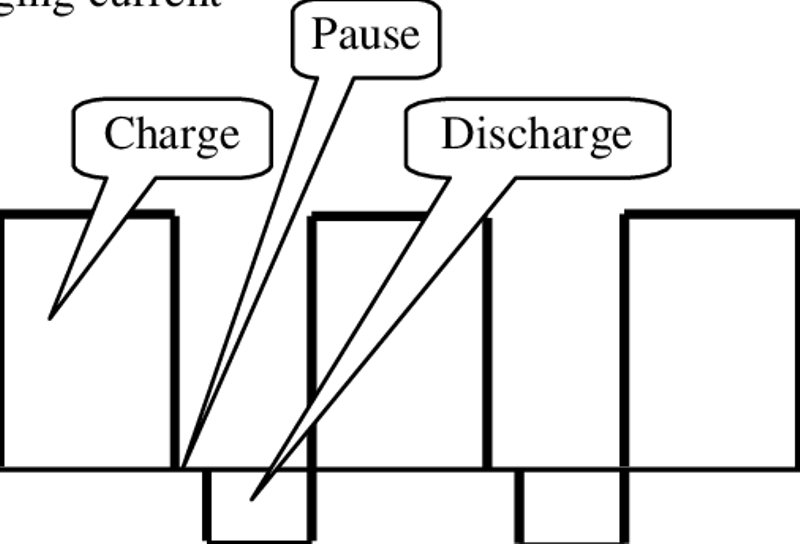
Pulse charging is a series of periodic current pulses, with short rest (or discharge) periods between. This helps avoid a voltage difference between battery terminals or reaching upper voltage limits to soon. Pulse charging lithium-ion batteries this way shortens charging time. While also possibly increasing efficiency, lowering temperature rise, and extending battery lifespan.
More About Lithium-Ion Pulse Charging
The Science Direct article that we link to below strikes a cautionary note. Experimental research confirms some pulse charging benefits. But other opinions are vague and open to dispute.
This is how the pulse charging lithium-ion batteries works in overview terms:
- Voltage increases during pulses to the same level before the interruption.
- When the charge voltage reaches a gassing level, the pulse interrupts.
Two phenomena may occur during this process. Battery gassing (which naturally occurs in charging batteries) may be less and enhance safety. While on the downside, there may be higher negative electrode polarization.
So Much for Pulse Charging Theory – Let’s Dig Deeper
We depend on lithium-ion batteries in so many ways. They have many advantages, although inappropriate charging and using them beyond recommended temperatures can make them deteriorate faster.
Appropriate battery charging should increase battery cycle life and make lithium-ion batteries safer too.
We came across some recent research on the Science Direct Journal of Energy Storage we link to below. There, several Canadian researchers report several interesting findings with particular reference to lithium-ion batteries:
- Inappropriate lithium-ion battery increases the rate of degradation and the fire risk.
- Pulsed current charging can improve lithium-ion safety, performance, and cycle life.
The researchers who wrote the article concluded that, “pulsed current charging strategies can significantly enhance the performance and longevity of lithium-ion batteries.
“However, their effectiveness is highly dependent on precise tuning of key parameters, including pulse frequency, duty cycle, current amplitude, and ambient temperature.”
More Information
Pulsed Charging and Its Positive Benefits
Faster Solid Battery Charging at KAIST
Preview Image: A Pulse Charging Cycle