Scientists at Rice University in Texas, delved into thorny dendrites in lithium-ion batteries and revealed something new. They discovered how their ‘stiff brittle behavior’ explains how they penetrate other materials.
Before this, dendrites have remained an enigma, because they can penetrate a lithium-ion battery’s separator and short-circuit the electrodes. Stay with us as we share how the research evolved.
It’s How We Observe Thorny Dendrites
We had not connected the dots before, that most materials look different when we view them at nanoscale. This is a level of magnification where scientists can observe items 100 times smaller than the width of a human hair.
Now here’s where the difference comes in. Bulk lithium metal is soft in our world. It deforms significantly before it breaks in response to physical force. Whereas lithium dendrites behave differently at nanoscale level.
The Rice University team did not know how thorny dendrites in lithium-ion batteries behave at nanoscale, before they began their research. This was because nobody had ever directly measured their mechanical properties before.
“Our work addresses this critical knowledge gap,” the co-corresponding author of the study says. “We directly probed the mechanical strength of individual dendrites harvested from a real battery.”
Testing Lithium-Ion Dendrite Responses
The Rice team ensured that their observations would be accurate, by working under strictly controlled conditions. This was because even a trace of air affects lithium’s chemistry and structure.
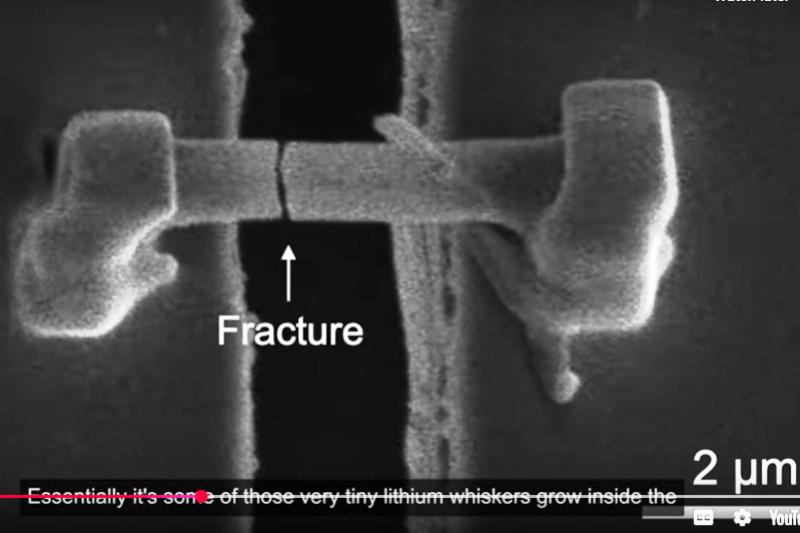
They watched what happened in a special lithium-ion battery at nanoscale level, using high-resolution electron microscopy. This enabled them to take unprecedented measurements of how lithium-ion dendrites responded to physical stresses.
“Contrary to common assumptions, we found that lithium dendrites exhibit unexpectedly high strength, and brittle behavior under mechanical stress.”
Dendrites obtain their strength by self-coating themselves with a minute layer of the solid electrolyte interphase as they form. This enhances their structural rigidity, and explains how they penetrate other battery materials.
More Information
The Origin of Dendrites Revealed By NMR
Watching Dendrites Grow in Real Time