Film capacitors are functionally similar to ceramic capacitors because they are both non-polarized. We can connect them either way around in a direct current environment. The film dielectrics are usually plastic film. Sometimes they team this with paper. Their purpose is to convey electrons.
How Manufacturers Put Film Capacitors Together
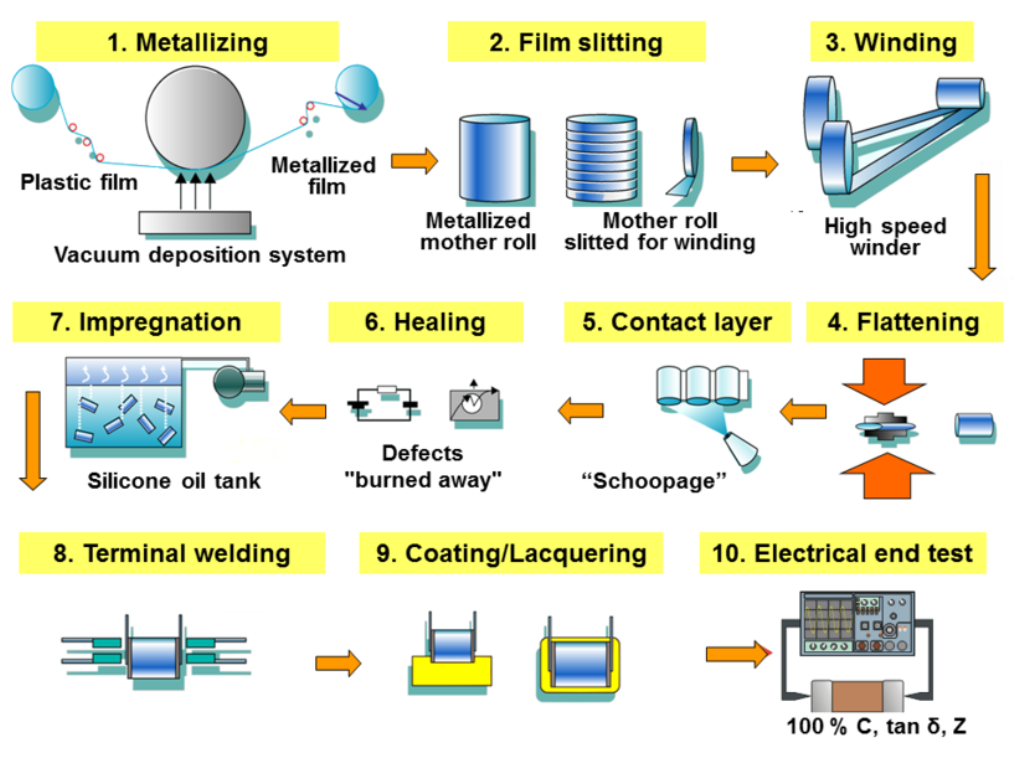
Since size matters, manufacturers first draw the dielectric film to an extremely thin thickness according the electric strength they desire. Then they apply metallized aluminum or zinc coatings directly in order to form a conductive layer. In practice, film capacitors comprise several layers. They may take the form of cylindrical windings. However they are usually flat to minimize mounting space. Here is an info graphic of how this works in practice.
Two Different Types of Film Capacitors
The choice really boils down to how much surge we want the capacitor to stand. Film / foil or metal foil capacitors can survive high current surges. Their dual dielectrics have layers of metal, usually aluminum foil. Consequently this design simplifies electrode attachment making them reliable. Thus they are simple and effective until they fail.
By comparison, metallized-film-capacitors have aluminum metallization on layers of plastic film deposited in a vacuum. There are ‘self-healing’ properties inherent in this design. Hence short-circuits between electrodes do not necessarily result in component self-destruction. This brings us closer to zero-defect capacitors. But the problem is the surge rating is lower and they are less robust.

Film Capacitors Have Many Applications
Film capacitors are better suited to general-purpose and industrial applications than their ceramic and electrolytic cousins. They may be larger and more expensive. But film / foil or metal foil capacitors can survive high current surges and have more stable electrical parameters. Perhaps the simplest place to find one is in the lighting ballasts in the ceiling of your favorite store.
Related