Corrosion in anode-less aqueous zinc batteries is one of the greatest challenges preventing their commercialization. Scientists find them interesting, because they use water-based electrolytes.
These electrolytes are safer and cheaper than the flammable liquids in many lithium-ion batteries. They are also capable of high energy density, because they do not contain a thick zinc metal anode when manufactured.
How Corrosion Develops in These Zinc Batteries
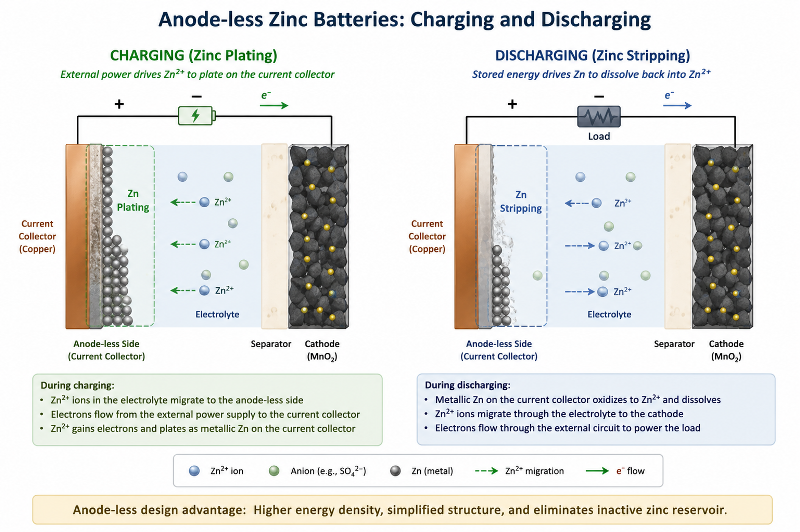
Zinc metal deposits onto a current collector during charging, and becomes the working anode. During discharge, that same zinc should dissolve back into the electrolyte. But the water in the electrolyte can react with some of the zinc as it arrives.
This corrosion can cause unwanted side reactions that consume the zinc metal and reduce battery life. Scientists have established that this corrosion often occurs alongside hydrogen gas evolution, and the formation of insulating by-products on electrode surfaces.
Corrosion in anode-less aqueous zinc batteries can also encourage the growth of zinc dendrites. These tiny, needle-like structures may eventually damage the battery.
Scientists are working on protective coatings, new electrolyte formulations, and engineered interfaces, to reduce contact between zinc and electrolyte, while still allowing zinc ions to shuttle freely.
New Hope on the Horizon for Anode-Free Zinc
Researchers at Tsinghua University in China, have demonstrated that galvanic corrosion occurs between the zinc and the current collector. They prevented this unwanted reaction by introducing a polymer insulation. This stops the galvanic reaction, yet allows the ions to flow.
This in turn enables stable zinc plating, and subsequent stripping. This work demonstrates a way to prevent corrosion in anode-less aqueous zinc batteries, and potentially advance their eventual commercialization.
More Information
Aqueous Zinc-ion Batteries Back on Table