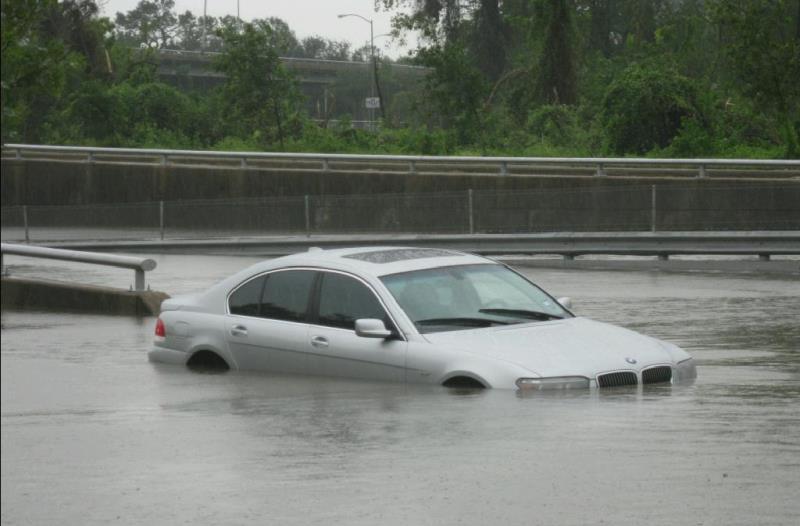
Driving EVs through water safely in not always possible. It may be okay if the water is not too deep, and the battery and electrics stay dry. Electric vehicle makers do their best to waterproof their batteries. We did not previously imagine them doing so with a rubbery membrane around the battery case.
The Risks of Driving EVs Through Water
No vehicle that we know of enjoys being seriously flooded, for example during a hurricane. The water rises up from below, and creeps in past the door and window seals.
The upholstery is a mess afterwards, while some electronic accessories suffer permanent damage too. To make matters worse, the water can start corrosion in hidden corners where it is not supposed to go.
However, and this is the point of this article, it may be even more impractical to drive EVs through water safely, because of their main primary batteries. The issue here is how long the electric vehicle and the battery are exposed to water.
An electric vehicle battery, as you probably expected, adds another worry to the risks we mentioned. If water seeps past the protective casing, then this can cause a short circuit and damage some cells.
In a worst-case scenario, water damage can lead to a battery fire, and destroy the entire vehicle!
Novel Way to Protect an EV Battery From Water
The European Rubber Journal advises us of a new way to water-proof an electric vehicle battery. Although this does not necessarily mean that deliberately driving EVs through deep water safely is a good idea.
The material in question is an elastomer membrane. This had us rushing to Google to discover this is a flexible, rubber-like sheet, made from materials that can stretch and return to their original shape.
But will this actually work in practice? The European Rubber Journal advises that a leading German motor manufacturer has purchased a million elastomer membrane sheets. This sounds like something to consider carefully.
More Information
When Lithium Batteries Get Wet Inside
Revolutionary Rubber Battery for E-Vehicles