When people discuss Alessandro Volta, they usually remember him as the inventive spirit behind batteries. However, his work went further than creating electricity from chemicals. He also explored a way to store it.
The Creative Spirit Who Invented Batteries
You first need to have something, before you can store it. Volta invented the voltaic pile in 1799, when he stacked discs of zinc and copper, with cloth soaked in salt water between them.
This combination produced a continuous flow of electricity after he completed the circuit. This was a turning point in the history of electricity. Because, before that, scientists could only generate static electricity in brief bursts. But now they had a dependable source of power, that they could study and use.
However, there was more to what the inventive spirit behind batteries built. He had proved, for the first time, that chemical reactions could generate a steady flow of electricity.
This insight became one of the central principles of the electrochemical batteries in our phones and wearables. Lead-acid, lithium-ion, sodium-ion, and zinc-air batteries all rely on the same basic principles.
Electrical Capacitance Took Batteries a Stage Further
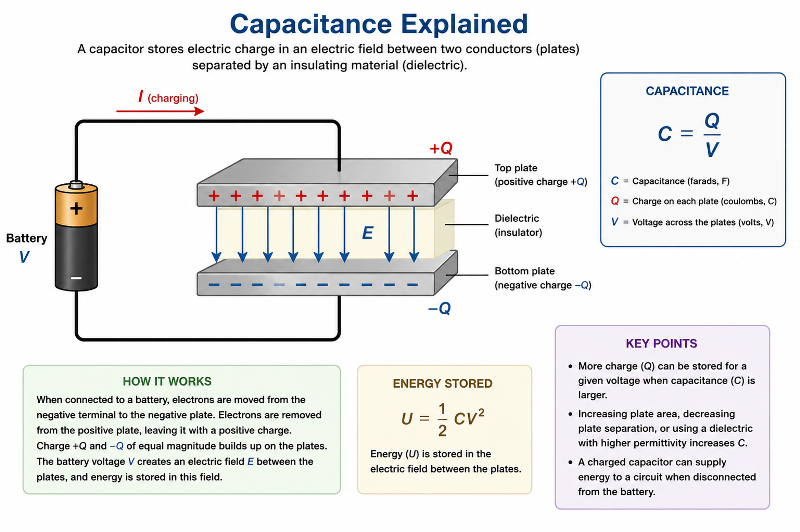
Volta also made an important contribution to the study of electrical capacitance. This phenomenon is the ability of a system to store an electrical charge. Remember that before this, Volta could only deliver his electricity for the present moment.
Modern capacitors and batteries store energy in different ways, although both involve the movement, storage, and release of electrical energy. Volta’s investigations helped early scientists understand how a charge accumulates, how we can measure it, and how electrical systems behave.
Alessandro Volta’s Inventive Spirit Lives On
Viewed together, these achievements reveal a broader story. The voltaic pile showed how electricity could be produced from chemistry. While Volta’s work on capacitance helped explain how to store and manage electricity.
His first contribution advanced practical power sources. The second deepened our scientific understanding. This combination of experiment and theory helped transform electricity, from a scientific curiosity into a field of study.
In so doing, Volta laid important foundations for electrochemistry behind the batteries that power our lives. His inventive spirit lives on through the research we follow on this blog.
More Information
The Fitzgerald Paper Capacitor of 1876