

Each time we replace a battery in a favorite device, we may wonder how long it may last this time. But we have probably forgotten that thought by the time it dies on us though. New battery developers have adopted the same approach until recently. But this is changing. Researchers at U.S. Argonne National Laboratory have found AI steadily improves new battery performance in their lab.
New Battery Performance Steadily Improves With AI
Computers use their machine artificial intelligence to perform data processing tasks faster than a human ever could. Now researchers at Argonne – see link below – are replacing time-based prototype trials with AI simulations. This saves a deal of time and money and moreover accelerates the program.
“This enables us to recognize patterns in data sooner,” says electrochemist Susan Babinec who co-authored the study. Her team are able to accurately predict how long it will take particular batteries to degrade sufficiently to stop working. This was after they gathered experimental data from 300 batteries representing six different chemistries according to Popular Mechanics.
Different Cathodes May Degrade Quicker or Slower
A cathode is the metallic electrode of a battery, through which current flows out into a polarized electrical device. Cathode capacity is the amount of energy it can store, and deliver. However, this load gradually declines with repeated discharging / recharging cycles.
“Different cathode types can store more or less energy,” says Noah Paulson, a computational scientist at Argonne. “But they may also degrade quickly or more slowly. We have trained our AI to understand this, using a known chemistry. And it is now able to make predictions about unknown chemistries too.”
This new method has potential to accelerate the development and testing of battery materials. This could radically shorten the time to decide whether a new chemistry is worth exploring further or not. Therefore this work is of critical importance, given battery’s role in rolling out renewable energy.
Breaking News:
Could Electric Eels Give Batteries a Few Tips?
Hybrid Power Plants Adapt to U.S. Markets
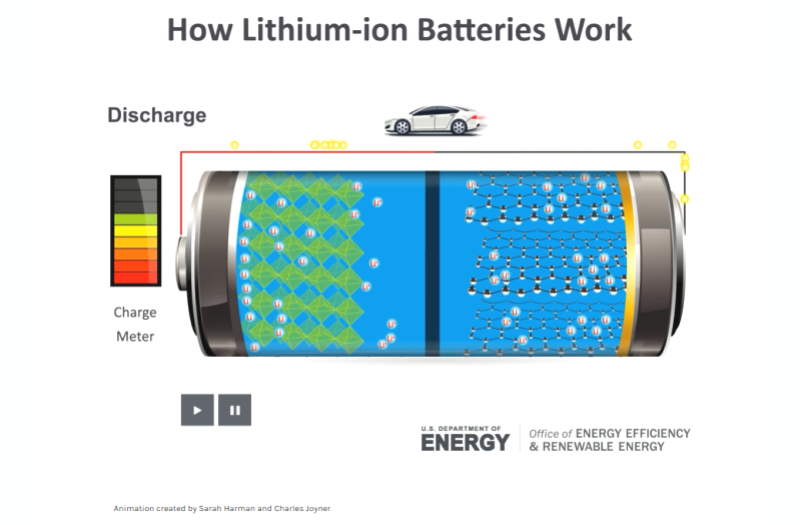
Preview Image: A Lithium Battery Discharging
YouTube Share Link: https://youtu.be/PyrWx4ExZE4


