

We were beginning to fear vaccinated people with breakthrough infections could make other people ill. This was a stressful thought, because it meant the infections would keep spreading. However, we are delighted to share news COVID breakthrough transmission risk is lower than we thought.
Why COVID Breakthrough Transmission Risk is Actually Lower
Ross Kedl is an immunologist at University of Colorado School of Medicine. He explained to NPR News October 12, 2021 how this works. In a nut shell, breakthrough transmissions may still occur, but they are a lesser risk to other people.
Viruses of vaccinated people are different, Kedl continues. That’s because they already had antibodies when they arrived. And those antibodies will coat the invaders making them less virulent if they spread. Even if this happens, he explains, there will be less downstream transmission.
Moreover, where there are outbreaks of secondary infections among vaccinated people, these happen when there also unvaccinated people present. An Israeli study of infected, vaccinated health care workers concluded the source was inevitably an unvaccinated person in every case.
New Laboratory Evidence mRNA Vaccines Are More Effective
Michael Casper Tal is a visiting scientist at Massachusetts Institute of Technology. Prior to that, he was an instructor at Stanford University’s Institute for Stem Cell Biology and Regenerative Medicine. Tal has been conducting research as member of a team, and has made an exciting discovery (see link below)
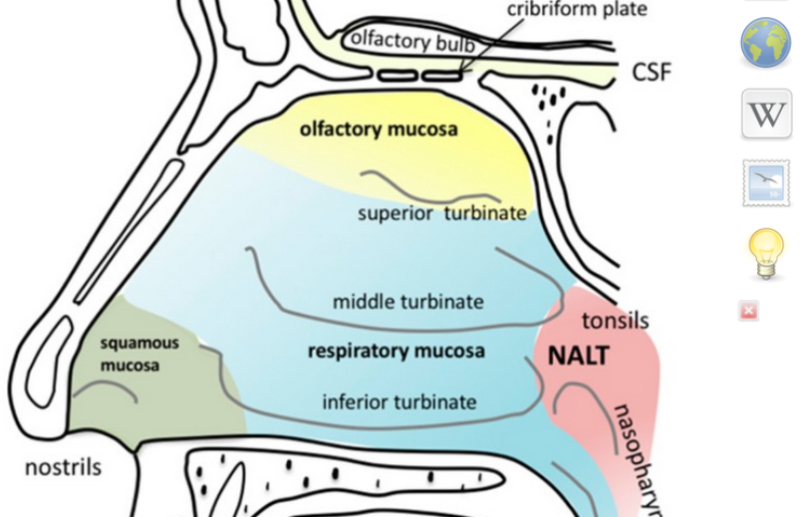
Tal and his colleagues studied the distribution of antibodies in people with mRNA vaccines, such as Moderna and Pfizer. He knew he would find these circulating in their blood. However, he also discovered ‘a surprising amount’ in mucosal membranes in their mouths and noses’. And these, as we know are the coronavirus’s main entry points.
This evidence of lower COVID breakthrough transmission risk is proof we are not ‘sitting ducks’, he believes. Immunologist Jennifer Gommerman of University of Toronto concurs. ‘This is the first example where we can show that a local mucosal immune response is made,’ she says. ‘Even though the person got the vaccine in an intramuscular delivery.’
Breaking News
The Human Immune System Protecting Us
Kids Almost Likely as Adults to Get COVID-19
Preview Image: The Human Nasal Cavity


