Trials of prospective medication, especially critical vaccines need to be as objective as humanly possible. This is because mental factors can knock through to physical responses, and influence results. We explore double blind random experimental testing in this post. That’s because vaccine trials are large-scale experiments to test the assumption a vaccine is effective, or otherwise.
What is Double Blind Random Experimental Testing?
Randomized clinical trials are experiments where neither the administrator, nor the subject knows which shot is being used. It could be the real thing, a different medication, or a neutral placebo. Scientists call this method double blind random experimental testing, because neither party has ‘sight’ of the truth.
Of course, each shot will have a random serial number, and that record will appear in patient and test records. This method minimizes the human factor, and improves the statistical reliability of a clinical trial. It also also helps ensure subject expectations, and observer / administrator influence should not play a significant role.
‘Un-Blinding’ As the Experimental Trial Proceeds
Other resources, often computers are ‘sighted’ and able to interpret the random serial numbers. However, this information is out of reach of administrators and subjects, until the experimental trial is complete. Thereafter, the information may be provided to individual subjects, as a polite courtesy.
There are two common variations of double blind testing. The first is single-blind, where only subjects are in the dark. While triple blind trials also keep the data from third parties, such as monitoring committees.
Random, double blind placebo controls are the ‘gold standard’ of epidemiological studies. This is according to National Center for Biotechnology Research, per the link at the end of this post. Vaccines trialed outside this method may turn out flawed, and the benefits questionable.
Related
Monoclonal Antibodies Trialing in the UK
AstraZeneca Trials Are Continuing in UK
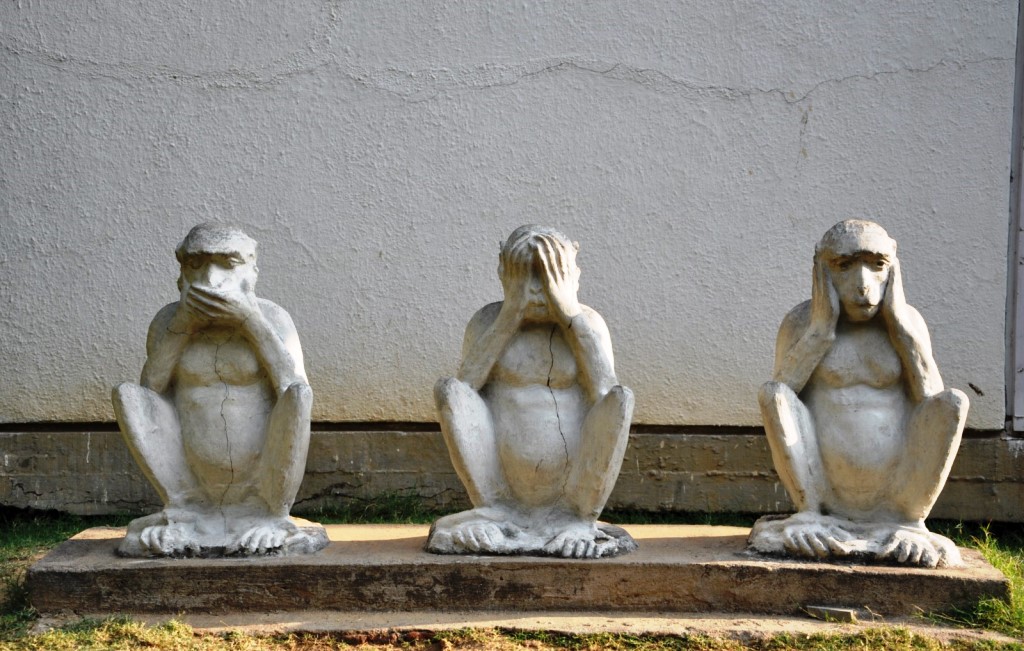
Preview Image: Mahatma Gandhi’s Three Monkeys