Researchers at Argonne National Laboratory decided to microscopically observe a lithium-ion battery during fast l-ion charging. They wanted to learn more about the lithium-plating process that retards long-term cell performance. “We’re gaining the ability to precisely determine the inhomogeneous way a battery ages” battery scientist Daniel Abraham confirmed. “By seeing exactly how the lithium is distributed within the electrode.”
Fast L-Ion Charging Essential for EV Future
Battery scientist Daniel Abraham believes fast l-ion electric car charging is essential for the future of electric vehicles. “We’d like to be able to charge an electric vehicle battery in under 15 minutes, and even faster if possible.”
That’s because the current process takes far longer for impatient divers than topping up with gasoline. Accordingly, Argonne scientists are hard at work and hoping to see a more level playing ground in future.
They understand how cathode lithium ions obediently slot between the planes of carbon atoms in graphite anodes during slow charging. However, this order breaks down in fast charging mode.
How Lithium Ions Plate During Fast Charging
During fast l-ion charging cycles, some of the lithium ions fail to slot between the planes of carbon atoms. Instead, they plate the surface of the anode in a process called lithium plating. This dramatically reduces battery performance because the electrodes can no longer exchange those lithium ions.
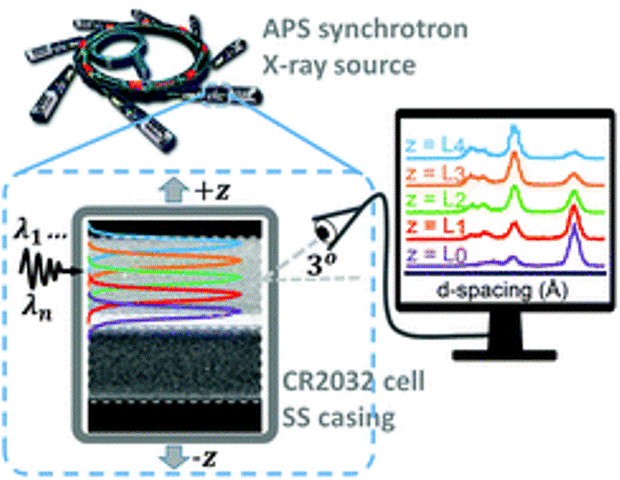
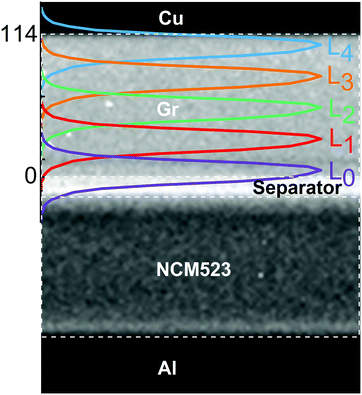
The Argonne study we report here involved microscopically tracking the movement of lithium ions in a battery. Researchers were able to precisely measure the quantity of lithium in various parts of the anode during charging / discharging. Moreover, they discovered more lithium accumulates closer to the separator during fast l-ion charging. “You might expect that just from common sense,” battery scientist Abraham comments.
“But by seeing exactly how the lithium is distributed within the electrode, we’re gaining the ability to precisely determine the inhomogeneous way in which a battery ages.”
Related
Phone Charging Overnight Shortens Life
Will Fast Charging EV Batteries Last 5 Years?
Preview Image: Beginning of Lithium Plating Process on Graphite Anode