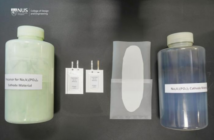
Researchers at the Japanese Atomic Energy Agency have succeeded in assembling the world’s first depleted-uranium rechargeable battery. They hope this will become an additional use for the material in the immediate future. One option they mention could be large battery farms capturing power from solar energy. But how safe would this idea be in practice?
How Safe Would Their Uranium Rechargeable Battery Be?
Depleted uranium is a largely underutilized by-product of nuclear fuel production. Wikipedia reports several commercial applications, where the depleted radioactivity of the dense material is preferable to the original version.
Civilian applications include counterweights in aircraft to balance control surfaces, and rotating engine components. As well as radiation shielding in medical radiation therapy, radiography equipment, and containers for transporting radioactive materials.
The U.S. Environmental Agency reports that depleted uranium is chemically toxic, and can harm kidneys if ingested. Inhaled particles could cause internal damage too, although this is unlikely outside of industrial processing facilities.
The Japanese Atomic Energy Agency does not comment on the safety of their first uranium rechargeable battery, in their announcement. Although we may assume they incorporated this factor in their design.
Moving Towards a Depleted Uranium Flow Battery
The research team explains how they harnessed the chemical properties of uranium, in their report we link to below. They were successful, because their battery was practical and able to charge and discharge ten times.
The voltage of the single-cell prototype battery, which proved stable, was 1.3 volts. This is close to the 1.5 volts of alkaline versions.
The team are now developing depleted uranium fuel cells, such as the example that appears at the beginning of this article. They are working on designing the electrodes for what will become a redox flow battery.
Japan holds a store of 16,000 tons of depleted uranium, according to the Japanese Atomic Energy Agency. If their scientists can find a way to increase the voltage, then this could become a winner for grid energy storage.
More Information
Nuclear Fuel Cells Fit For The Moon
Nuclear Batteries and Regulatory Oversight
Preview Image: Diagram of Uranium Flow Battery