Gaston Planté was a physicist born 22 April 1834 in Orthez, France near the Spanish border. He began his career as a research assistant at the Paris Conservatory of Arts and Crafts. He discovered the fossil remains of a six-foot-tall flightless bird. Four years later, in 1859, Gaston Planté’s lead-acid cell entered the record books. At the height of his career he rose to the post of a polytechnic professor’
Why the Fuss Over Gaston Planté’s Lead-Acid Cell

Earlier batteries, including Volta’s voltaic pile and John Dancer’s porous pot cell were once-off affairs. In other words, after they spent their energy they were only useful as scrap.
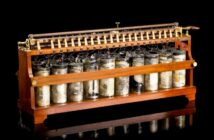
Gaston solved this problem by inventing the world’s first lead acid battery that could recycle a number of times. Sadly, no drawings or photos of this wonderful creation survived.
However, we do know Gaston Planté’s lead acid-cell comprised two sheets of pure lead with a linen cloth separator between. Gaston rolled these into a cone-shaped spiral a little like a snail shell. Then he placed this in a glass jar he filled with a sulfuric acid solution. “Voila,” he may have said. “C’est magnifique,” or words to that effect. But that’s just a guess!
How Camille Alphonse Faure Took the Invention Further

Gaston presented a nine-cell version to the French Academy of Sciences in 1860. Then his restless, curious mind moved on to investigating the differences between static electricity and electricity from batteries.
So it was up to his compatriot Camille Alphonse Faure to follow through and commercialize the product.
In 1880, Camille patented a process for coating lead plates with water, lead oxide, and sulfuric acid paste. Then he cured this in a gently humid atmosphere. This converted it to an amalgam of lead sulfate still adhering to the plates. This substantially increased lead-acid battery capacity. There probably would not have been a UPS Battery Center without the ingenious Gaston Planté’s lead-acid cell.
Related
Calcium and Other Advances in Lead Acid Battery Technology
Sealed Lead Acid Batteries – The Basics
Preview Image: Gaston Planté