


The power to overcome adversity is the mark of many famous people. Beethoven wrote his Ninth Symphony after he became deaf, because he could hear better in his mind. Steven Hawkins could peer into the future of the universe farther than most. Let’s discover how Henry Cavendish, who lived from 1731 to 1810 turned childhood autism to his advantage.
How Childhood Autism Liberated Henry Cavendish

Contemporaries described Henry Cavendish as ‘a notoriously shy man’ entirely happy with his thoughts. Hence, he did not particularly care what people thought, when he postulated theories well ahead of his time. He simply published his findings and moved on.
This intellectual freedom empowered him to examine the composition of atmospheric air, the properties of different gases, and the synthesis of water. He also researched electrical attraction and repulsion, and came up with a mechanical theory of heat. John Cavendish is perhaps best known for calculating the density, and hence the mass of the Earth. He came within 1% of the currently accepted figure after scrupulously eliminating every possibility of error.
Henry Cavendish’s Unpublished Chemistry Research

In later years, Henry Cavendish acquired an assistant, Charles Blagden as his representative with London’s scientific society. In return, the younger man ‘helped to keep the world at a distance’ according to Wikipedia.
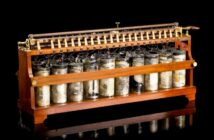
We know from surviving manuscripts that Henry Cavendish investigated mechanics, optics, and magnetism although he hardly published anything. He conducted significant experiments using Leyden Jars to discover the fundamental laws of electricity. However, this knowledge died with him. Michael Faraday, Georg Ohm, Charles Coulomb, and James Maxwell reached similar conclusions decades later.
The private life of Henry Cavendish has deep lessons for society, when it comes to re-advantaging our autistic sisters and brothers. They are often highly creative people with an obsession for detail. We wonder what Henry would be turning over in his mind, were he alive today.
Related
Georg Ohm: The Mozart of Electricity
Preview Image: Apparatus Regarding Factitious Air

1 Comment
I don’t blame him.