Battery scientists at Tianjin University in China have found a way to double up on lithium-ion battery density. Such a modified battery could hold twice the amount of energy in current lithium-ion versions, relative to bulk or weight. This lithium-ion breakthrough in Tianjin could revolutionize electric transport, and get us to where we need to be sooner.
Twice the Driving Range from Lithium-Ion Chemistry
Lithium-ion batteries play a critical role in electric vehicles. They store a relatively large amount of power, according to their size and weight. Tesla’s lithium-ion EV batteries store approximately 300 watt-hours per kilogram, according to Tech Explore.
Whereas the proof-of-concept lithium-ion battery prototype that Tianjin University developed, offers 600 watt-hours energy storage per kilogram. This suggests that future eclectic vehicle batteries could be smaller and lighter, while increasing the vehicle’s driving range and power.
The Technical Breakthrough Behind These Claims
Lithium-ion battery chemistry has reached a semi-stalemate, in the way it allows ions to shuttle between electrodes during charging and discharging.
As we understand it, the ions currently travel in a semi-chaotic fashion through the liquid electrolyte. They can clog into clusters that holds them back, and limits battery stability, performance, and efficiency.
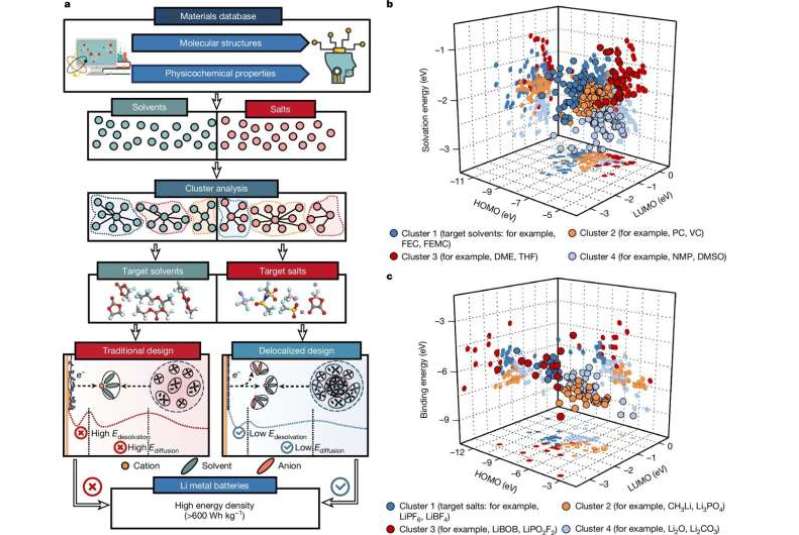
The Tianjin team investigated this phenomenon. They determined it was a consequence of the way the electrolyte dominated the flow of the ions. To resolve this, they created a novel, ‘highly-disordered’ electrolyte instead.
Impressive Results From the Tianjin Breakthrough
The lithium-ion breakthrough in Tianjin, achieved an impressive energy density of just over 600 watt-hours per kilogram. This is far in excess of anything else achieved to date.
But that was not all. The modified electrolyte did not ignite from an open flame. It comfortably handled over 100 charge / discharge cycles, and kept working at temperatures as low as -60°C / -72°F.
More Information
IMDEA Creates Smart Electrolyte for Li-Ion
Quantitatively Mapping Lithium-Ion Electrolyte