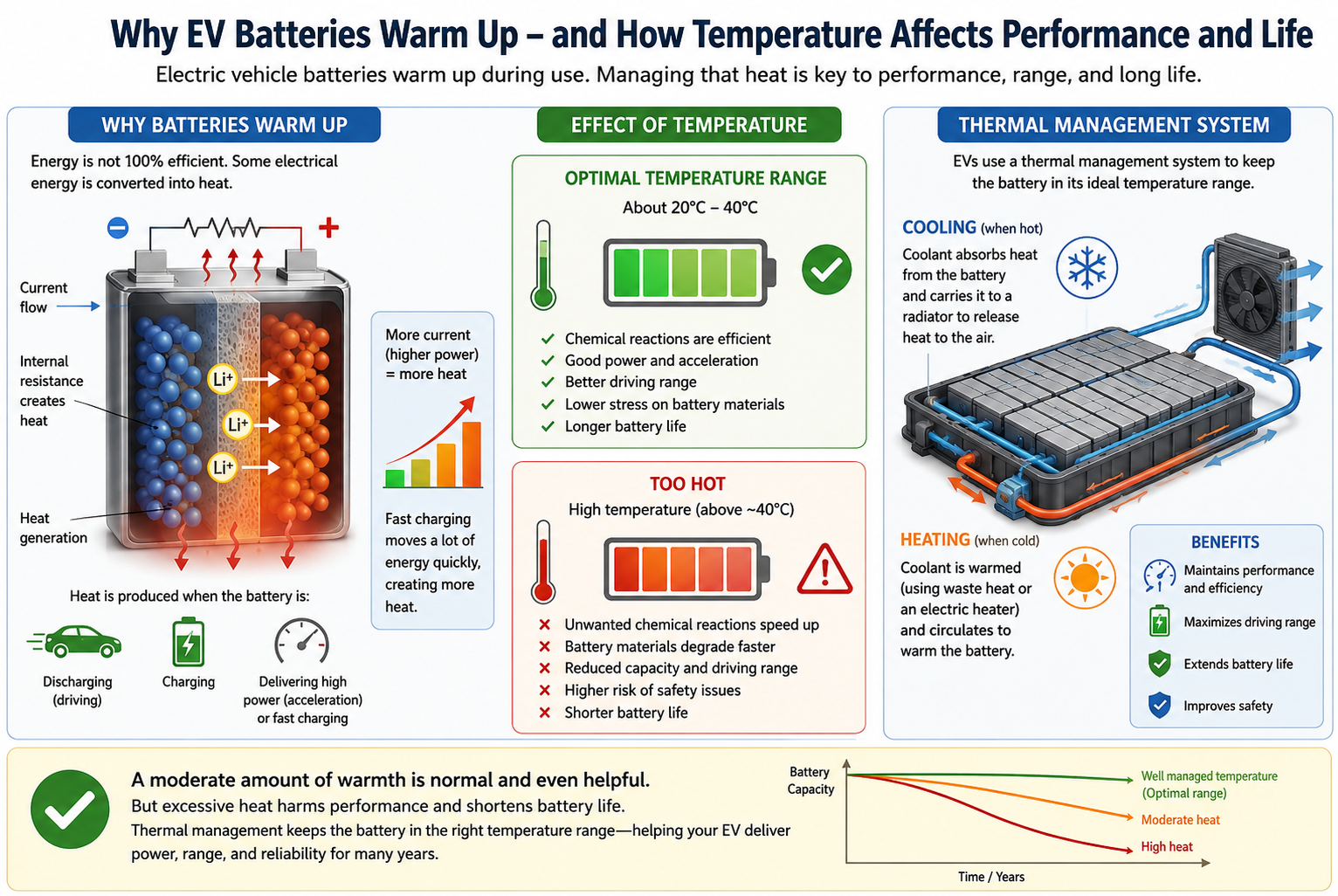
Electric vehicle batteries warm during use, because energy never transfers with perfect efficiency. Some of this energy converts into heat due to internal battery resistance. Until now, maintaining safe battery temperatures organically has been largely a pipe dream, but that could be changing.
Drilling Down Into Rising Battery Temperatures
Electric vehicle batteries also generate heat when they charge, discharge, or deliver high levels of power during rapid acceleration. Fast charging can create particularly high temperatures, because large amounts of energy move through the battery in a short time.
But a moderate amount of warmth is actually beneficial. Most electric vehicle batteries perform best within a controlled temperature range, typically between about 20°C and 40°C / 68°F and 104°F. Chemical reactions inside their cells occur more efficiently, allowing the battery to perform better.
However, excessive heat can be harmful, and speed up unwanted chemical reactions, causing the battery components to degrade faster. Over time, this reduces the battery’s ability to store energy, shortening driving range and shrinking their operating life span.
Countering Battery Warmth With Thermal Management
Maintaining safe temperatures organically has seemed to us to be on the back burner in news channels until now. However, that may be changing, thanks to work at University of Tennessee in Knoxville, United States.
The popular solution we have been following has involved inserting heat absorbing-materials between battery components. These are typically polymer matrices containing thermally conductive nano–materials. However, this has not been particularly effective…
The team from University of Tennessee, have come up with what we consider to be a fundamentally different approach. They have experimented with high-thermal conductivity bio-composites, they developed using synergistic microbial biosynthesis.
The researchers created these composites using in-situ biosynthesis of bacterial cellulose and fluorographene. The materials that emerged exhibited exceptional thermal conductivity, as well as thermal stability, mechanical strength, and electrical insulation.
Microbial biosynthesis appears to be a sustainable method employing natural materials.The method we describe here could have applications far beyond batteries. Based on our extensive appreciation of thermal management, it should find other uses beyond the scope of our blog.
More Information