

National Academies of Sciences, Engineering, and Medicine (NASEM) released a draft 115-page report on September 1, 2020. This provisional document is now open for opinions because it welcomes comment , and we therefore append a link to it below. However, the report’s draft priorities for COVID-19 vaccines sidestep the issue of minority group vulnerability. Instead, it focuses on the factors that create the risk.
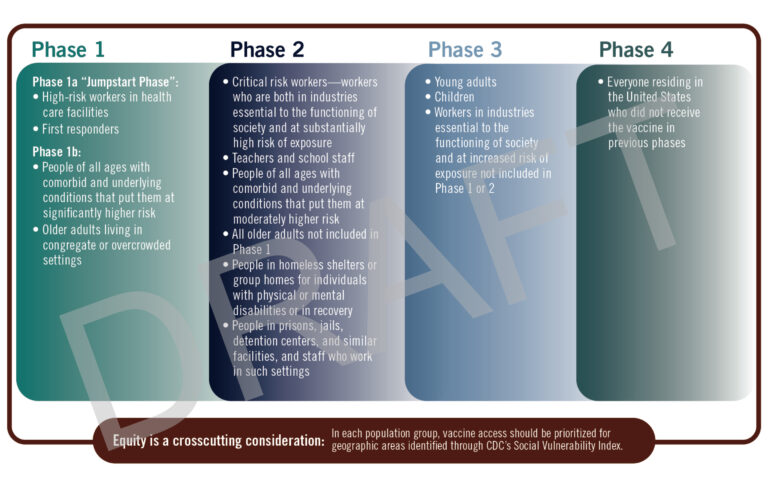
Phase 1 & 2 Draft Priorities for COVID-19 Vaccine
Phase 1 of the proposal first outlines people with the greatest likelihood of being in settings where the virus is circulating. And moreover are at risk of receiving a sufficient dose because they are:
… Phase I (a) Firstly, high-care facility workers and first responders
… Phase I (b) Secondly, people with high-risk co-morbities or older adults in crowded settings
Phase 2 includes workers in other critical roles, and people finding themselves in high risk situations. These are:
… Critical risk workers in essential roles at high risk of exposure
… Teachers and school staff due to regular close contact
… People with moderate-risk co-morbities and or underlying conditions
… Older adults not included in Phase 1
… People in homeless shelters, or group homes for those with disabilities
… Finally, people in prisons, jails, detention centers and those who care for them
Order of Priorities for the Remainder: Phase 3 & 4
Phase 3 addresses young adults, children, and workers in essential industries at increased risk of exposure.
Phase 4 sweeps up the remainder in a bucket list. Therefore, you are in Phase 4 if you reside in the United States but have not already qualified for the vaccine.
Risk-Creating Factors Behind These Draft Categories
NASEM’s draft priorities for COVID-19 vaccine allocation derive from the following risk factors because it deems them necessary for fair distribution:
1… The risk of acquiring infection
2… The danger of severe morbidity and mortality
3… The risk of negative societal impact
4… The probability of transmitting the disease
Related
Who Should Qualify to Get the Vaccine First?
Virally Vectored DNA versus mRNA Vaccines
Preview Image: Phased Approach


