Are smart clothing with fiber batteries an unreachable dream, or will we get there someday? We are confident that the latter is true, although it will take a while longer, we have no doubt.
We explore the problems holding back the intriguing thought of wearable batteries, and investigate whether there is light at the end of the tunnel.
Obstacles to Wearing Fiber Batteries in Our Clothing
We have followed deep research into the possibility of wearing smart clothing, and using fiber batteries to power other wearable devices. These could do wonders for biomedical sensors, and perhaps even soft robotics.
You see, their potential power lies in their ability to adjust to flowing, irregular, or curved surfaces. Yet, despite this, we seem not much further ahead than a year ago.
Scientists at North Carolina State University recently published a review that we link to below. The report they published on Wiley Online Library on February 16, 2026, highlights two major, persistent obstacles:
- How to securely contain lithium-ion battery chemicals so they cannot leak.
- The lack of mathematical models predicting the effectiveness of woven materials.
Drilling Deeper Into These Smart Clothing Obstacles
Securely Containing Lithium-Ion Battery Materials
Smart clothing must be able to resist oxygen and moisture from the air. While at the same time, wearable batteries must be sufficiently flexible to weave into clothing material.
Solving this obstacle remains one of the greatest challenges facing smart clothing with fiber batteries. The team from North Carolina State University are reaching out to the packaging industry for help.
Mathematical Models Predicting Wearable Performance
Developing smart wearable battery prototypes to the point where we can thread them into clothing, takes time and money. Moreover, there are so many potential options, that we might never uncover the ‘ideal solution’.
“The problem is that the models are not accurate enough to predict the effects of different device variables,” a researcher explains. This is a serious impediment to developing commercially-viable fiber batteries.”
More Information
A Wearable Battery That Self-Heals
Stretchable Batteries for Wearable Patches
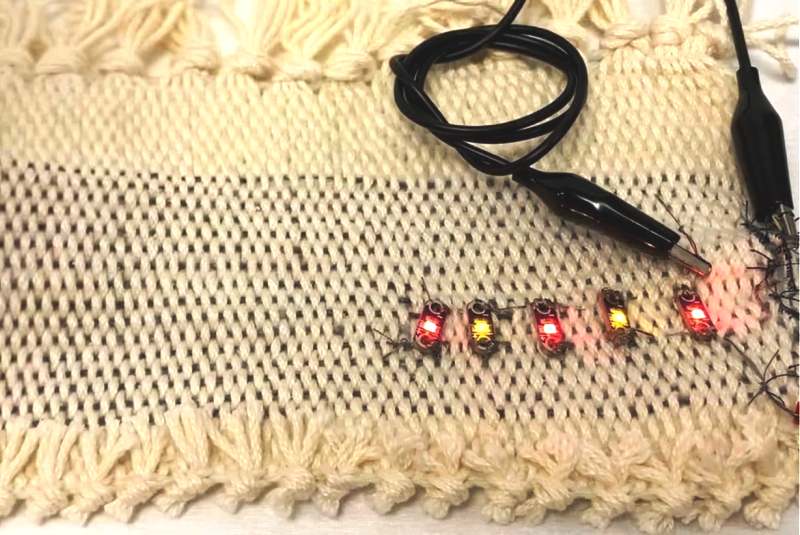
Preview Image: Yarns Integrated In a Fabric