NMC811 is short-hand for a lithium-ion battery cathode material containing about 80% nickel, 10% manganese, and 10% cobalt. Scientists at University of Arkansas have found that a sulfide coating boosts NMC811 performance, while countering premature degradation.
Why the Fuss Over The NMC811 Sulfide Coating?
The high nickel content increases cathode storage capacity, while manganese improves stability and cobalt supports conductivity and structural integrity. This is particularly attractive since using the nickel cuts the cost of a lithium-ion battery.
There is, however, an unfortunate downside to this promising cathode material with a high ratio of nickel. Charging and discharging the associated battery cell releases oxygen, and this degrades future electrolyte performance. The release can also affect battery safety and even lead to fires.
Towards a Solution For Degrading NMC811
The Arkansas team have made an intriguing discovery that could increase the lifespan of lithium-ion batteries. They have found that applying a thin sulfide coating to NMC811 cathodes, boosts lithium-ion battery lifespan as follows:
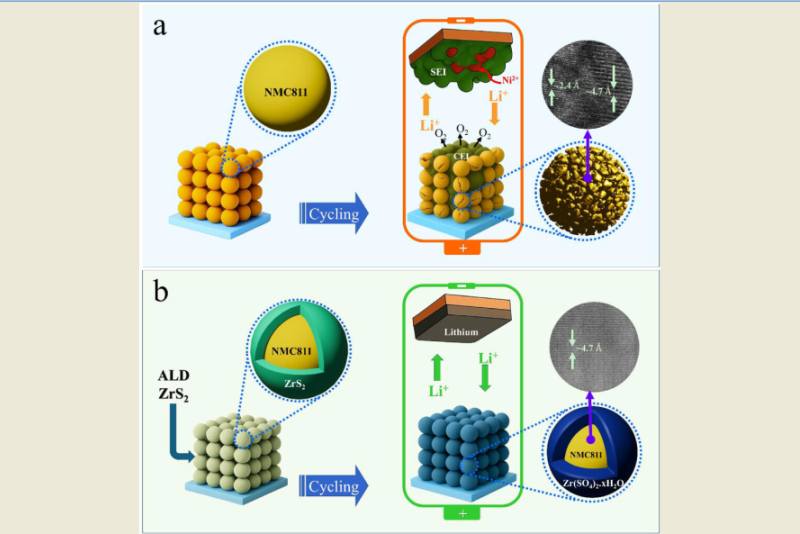
- They applied nanoscale coatings of zirconium sulfide to prefabricated NMC811 cathodes, by means of atomic layer deposition.
- The sulfide coating – just two billionths of a meter thick – captured the released oxygen by transforming the coating into a sulfate.
- This result has in turn been most effective at protecting the battery electrolyte from decomposition.
- The sulfate coating also inhibited other undesirable side-effects, and stabilized the NMC811 / electrolyte interface.
Impressive Performance With Sulfide / Sulfate Coating
The sulfate coating on the cathode materialized after the parent sulfide exposed to oxygen. The benefits were quite remarkable in terms of extended battery life:
- The original NMC811 cathode combination only survived for approximately 200 cycles.
- This increased to over 1,000 charge-discharge cycles after applying the sulfide coating.
- The modified battery still retained over 60% of its charge-carrying capacity after 1,300 cycles.
The principal investigator explains how, “the coatings are robust, clean and anti-oxidative protective layers on battery cathodes.” We understand that several large tech companies are already following up on the way sulfide coating boosts NMC811 performance.
More Information
Manufacturing High Performance Cathodes
Anodes and Cathodes and Their Roles
Preview Image: Bare and Coated Cathodes