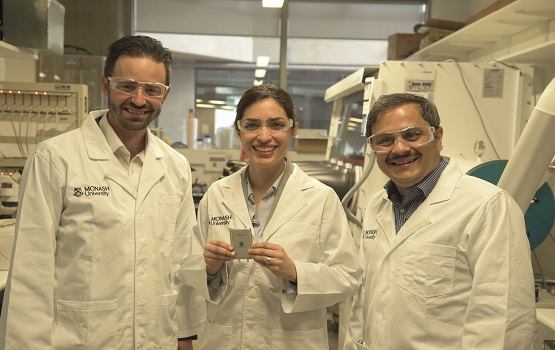
Next time your phone goes flat and you’re miles from a charging station you may feel like tossing it in the can. You’ll be fully entitled to wonder why lithium-ion battery technology is so backward. However, please take heart. Materials scientists at Monash University, Melbourne Australia have filed a patent for a battery that could help you talk for five days on lithium-sulfur power continuously.
On The Brink of Being Able to Talk for Five Days
New Scientist says the secret sauce is an ultra-high capacity lithium-sulfur battery. This has five times the storage of lithium-ion and retains 99% of efficiency after 200 cycles. Could this mean we finally have a commercial solution to sulfur expansion …
The Monash scientists think so. They are preparing to commercialize their sulfur batteries after developing prototype cells in Germany. They will test them in electric cars and on solar grids in Australia during 2020. This will confirm whether their method for countering sulfur expansion and cracking during battery cycling is sustainable. The lucky few assistants could talk for five days while driving for 625 miles between recharges.
Materials Science and Engineering at Monash University
A sulfur electrode is relatively large, and expands by 78% during charging / discharging cycles. This strains the material to the point it cracks and eventually disintegrates. Other manufacturers have had some success binding the particles together with additives. The team at Monash University took this a stage further by re-configuring their cathode to accommodate higher stress loads.
New Scientist says this involved reducing the polymer binding additive creating ‘more spaced-out structures between the sulfur particles’. The Australian government is contributing $2.5 million towards the 2020 testing program. The university reports inquiries from Europe and China regarding up-scaling production.
The Monash team says they obtained inspiration from bridging architecture that helped develop detergent powders in the 1970’s. What a way to rinse our phone battery troubles away.
Related
Comparing Lithium-Sulfur & Lithium-ion Cells
Lithium-Sulfur Batteries Tap Transport’s Door
Preview Image: Monash University Press Release / Research Team
Video Share Link: https://youtu.be/IWho9XYZqmc