This blog contains details of an experiment that may shock some sensitive people
How did we get to the point where electrons could flow from one electrode to another, inside batteries? To find that out, we’ll have to go back to the beginning of batteries. The day when a metal scalpel touched a dead frog’s leg hanging on an iron hook, and inadvertently launched the dawn of batteries in 1780.
Galvani Thought This Was Proof Animal Electricity Existed
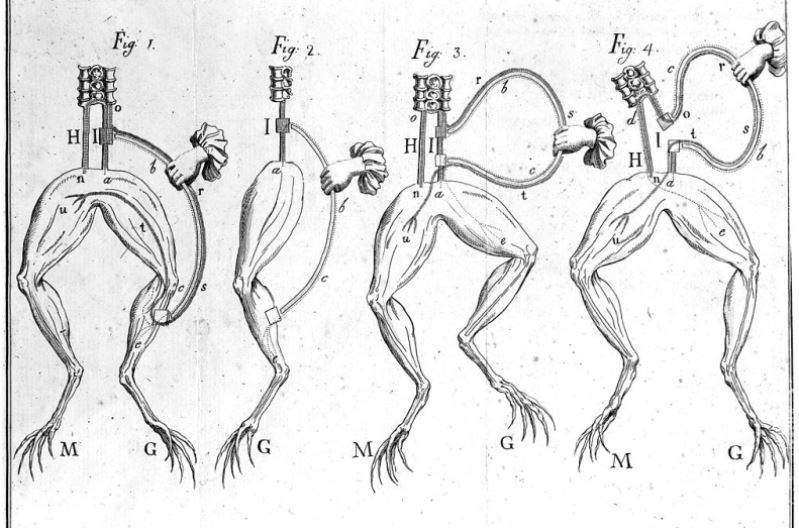
Luigi Galvani was a physician, physicist, biologist and philosopher living in Italy at the time. He was investigating his theory that ‘animal electricity’ in living creatures was a vital force giving life. He was experimenting with skinned frogs’ legs hanging on iron hooks, when the breakthrough happened.
Galvani was investigating how the frog’s legs convulsed in response to distant lightening, when his assistant touched a metal scalpel to the sciatic nerve. The leg twitched in the presence of the spark that followed. ‘Eureka’, Galvani may have exclaimed, convinced he had demonstrated ‘animal electricity’.
But Volta’s Skepticism Marked The Beginning of Batteries
Galvani’s pal Alessandro Volta was a physicist, chemist, and pioneer of electricity and power, also living in Italy. While he was initially impressed by Galvani’s explanation, on second thoughts he changed his mind.
He became more and more convinced an electric current had crossed between the iron hook, and the metal scalpel via the frog’s moist legs. And so he experimented with a pile of alternating layers of silver and zinc, separated by scraps of cloth, or paper, moistened with salt water.
Electricity flowed, as Volta had predicted, when he applied the ends of a wire to the bottom, and top of the pile. This result confirmed, in his mind, that Galvani’s assistant had caused the first galvanic reaction with the metal scalpel. And so this moment marked the beginning of batteries, as we know them now.

More Information
The First Battery Is Older Than You May Think