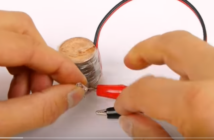
Testing motor efficiency is a great way for you to understand just how much the motor can actually do. There are ways to test this yourself – as long as you have the right materials and tools. The whole idea of this experiment is to compare the input work and the output work of the mechanism. We will use a battery-powered mechanism that is able to lift an object. The input work is the energy coming from the battery. The output work is the ability of the mechanism to lift the object despite factors like the increasing gravitational potential energy as the object is lifted higher. To be specific, we will be computing the electromechanical efficiency since the input work is electrical while the output work is mechanical.
What you will need:
- Mechanical device (see photo)

- Battery holder
- D cell battery
- 3pcs alligator clip leads
- Ruler
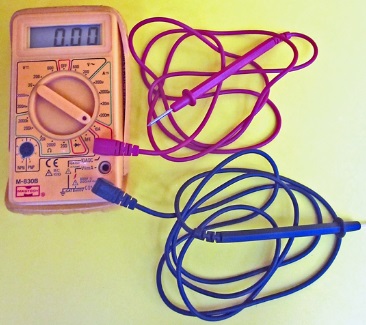
- Multimeter (with connecting probes) See photo
- Stopwatch or any timer
- Balance (e.g. digital balance)
- Metal paper clip or brass fastener
- Calculator
What you need to do:
- Take the mechanical device and open the battery compartment. It should be empty. Look for the contact strip where the positive end of the D cell battery would be connected. Insert the metal paper clip under that contact strip. This will help secure the alligator clip lead. The negative end usually have a spring so attaching the alligator clip lead should be easier.
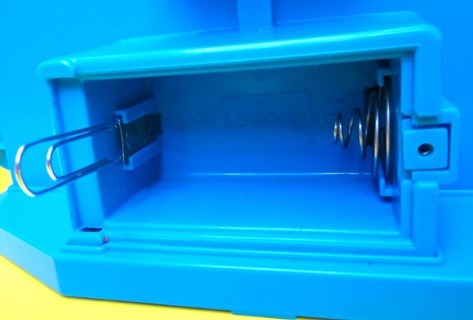
- Connect the battery holder and the multimeter to the mechanical device, by making the following connections:
- Positive end of the battery and the positive terminal in the battery compartment of the device.
- Negative end of the battery and the multimeter COM (common negative connection).
- Negative terminal in the battery compartment of the device and the multimeter positive connection.

- Set the multimeter to the 10A range.
- Compute the electrical input work that it takes the mechanical device to lift the object , in this case one dolphin. Use the formula: Win (input work) = V(volts) x I(amps) x t(seconds). The answer will be in joules.
- Compute the mechanical output work when the same object is lifted (e.g. one dolphin). Use the formula: Wout (output work) = m(kilograms) x g(meters/seconds2) x h(meters). The answer will again be in joules.
- Compute the efficiency when the mechanical device is lifting the same object (one dolphin). Use the formula: %Efficiency = Wout / Win x 100.
- Try changing the number of objects being lifted (e.g. 2 dolphins). See if the % efficiency will change.
What you need to know:
A mechanism is considered 100% efficient if there is no friction or hindrances as the mechanism does its work. That is because the input work equals the output work. But if there is a hindrance or friction involved, some of the energy exerted in the input work will be wasted. That will decrease the output work. The output work will always be lower than the input work.
Related Articles:
How To Create Your Own Motorized Car