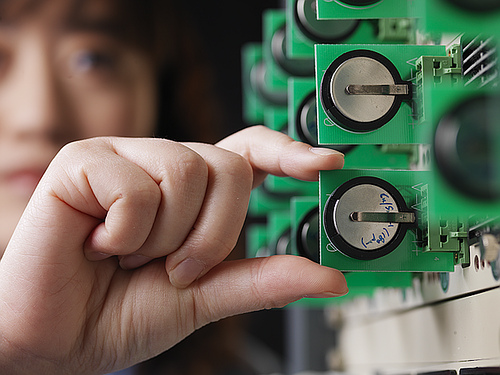
Researchers create longer-lasting, higher-capacity lithium rechargeable batteries, like the ones commonly used in consumer electronics. In a recent study published in the journal ACS Nano, researchers showed how a coating that makes high capacity silicon electrodes more durable could lead to replacement for lower-capacity graphite electrodes.
“Understanding how the coating works gives us an indication of the direction we need to move in to overcome the problems with silicon electrodes,” said materials scientist Chongmin Wang of the Department of Energy’s Pacific Northwest National Laboratory.
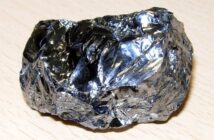
Silicon is currently one of the most popular options in lithium ion battery development because of its high electrical capacity potential. Replacing the graphite electrode in rechargeable lithium batteries with silicon could increase the capacity ten-fold, making them last several hours longer, before needing to be recharged.
The only problem with silicon electrodes is they aren’t very durable. After a few dozen recharges, they no longer hold electricity. This is due, in part, to how silicon takes up lithium like a sponge.
When charging, lithium infiltrates the silicon electrode. The lithium causes the silicon electrode to swell up to three times its original size. Silicon fractures and breaks down, possibly due to its swelling.
Researchers have been using electrodes made up of tiny silicon spheres about 150 nanometers wide, about a thousand times smaller than a human hair, to overcome some of the limitations of silicon as an electrode. The small size lets silicon charge quickly and thoroughly.
This is an improvement over earlier silicon electrodes, but only partly alleviates the fracturing problem. Last year, materials scientist Chunmei Ban and her colleagues at the National Renewable Energy Laboratory in Golden, Colorado, and the University of Colorado, Boulder found that they could cover silicon nanoparticles with a rubber-like coating made from aluminum glycerol. The coated silicon particles lasted at least five times longer. While uncoated particles only lasted 30 cycles, the coated ones still carried a charge after 150 cycles.
Researchers didn’t understand how the coating improved the performance of the silicon nanoparticles. In much the same way stainless steel forms a protective layer of chromium oxide on its surface, the nanoparticles naturally grow a hard shell of silicon oxide on their surface.
No one understood how the coating worked, PNNL’s Wang and colleagues, including Ban, turned to expertise and a unique instrument at EMSL, DOE’s Environmental Molecular Sciences Laboratory, A DOE Office of Science User Facility at PNNL.
Ban’s group, which developed the coating for silicon electrodes, called alucone, and is currently the only group that can create alucone-coated silicon particles, took high magnification images of the particles in an electron microscope.
The team discovered that, without the alucone coating, the oxide shell prevents silicon from expanding and limits how much lithium the particle can take in when the battery charges. At the same time they found that the alucone coating softens the particles, making it easier for them to expand and shrink with lithium.
The microscope also revealed that the rubbery alucone replaces the hard oxide. This allows the silicon to expand and contract during charging and discharging, preventing fracturing.
“We were amazed that the oxide was removed,” said Wang. “Normally it’s hard to remove an oxide. You have to use acid to do that. But this molecular deposition method that coats the particles completely changed the protective layer.”
At UPS Battery Center, our goal isn’t to only sell batteries, we want to inform and teach you about the amazing world of batteries, electricity and energy. Please check back for more interesting, helpful and informative articles about batteries and electricity.
Related Articles:
Scientists Find Garnet Ceramics May be Great for High-energy Lithium Batteries
Lithium Ion Batteries in Portable Electronics to Be Charged In 10 Minutes
What are Lithium-Sulfur Batteries?
Scientists Develop Cross-Linked Electrolytes To Make Lithium-Ion Batteries Safer
Nanocrystals: The Source Of Degradation In Lithium-Ion Batteries