Researchers at Colorado University in Boulder have a new theory why battery capacity reduces with age. Capacity refers to the amount of energy a battery stores, and it determines how long batteries last between charges. Consumers experience this phenomenon first hand, when they start charging smartphones more often as hydrogen molecules block lithium ions.
How Hydrogen Molecules Obstruct Lithium Ions
Batteries store their energy in microscopic ions, which are particles of atoms. These particles move between battery electrode anodes and cathodes, as cells discharge and recharge.
Scientists have known for a while that some of these ions become lost in the process, thereby reducing battery capacity. However, they have not fully understood why this happens, and where the missing ions go.
The team at Colorado University in Boulder appear to have partly resolved this mystery, by using Advanced Photon Source X-Ray equipment at Argonne National Laboratory. Their discovery may help your smartphone (and electric car) batteries hold their capacity longer in future.
Thanks to this ground-breaking work, we now know three very important things about lithium-ion batteries:
- Hydrogen molecules move from the battery electrolyte and gradually block the surface of the cathode.
- This action means there are less spaces than before on the cathode for lithium-ions to bind to.
- Fewer ions on the battery cathode translates to a weaker electric current, and therefore less capacity.
But, what will happen next, now we understand how hydrogen molecules block lithium ions, shortening battery life?
Thoughts From The Colorado University in Boulder
The first study author wraps things up by explaining, “The more lithium you pull out of the cathode during charging, the more hydrogen atoms accumulate on the surface.
“This process induces self-discharge,” they continue. “And causes mechanical stress leading to cracks in the cathode and accelerates degradation.”
The answer to this paradigm may lie in coating the cathode to prevent the hydrogen molecules gaining a foot-hold. But the solution could also be using a different electrolyte, that does not release hydrogen molecules. We’ll wait and see that happens next.
More Information
Lithium-Sulfur Battery Capacity Innovation
Reasons for Capacity Loss in Batteries
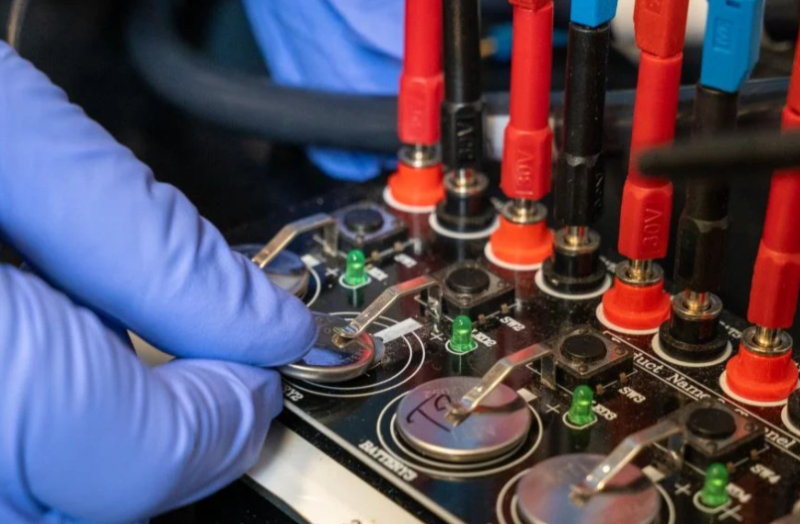
Preview Image: Tests Lithium-ion Button Batteries