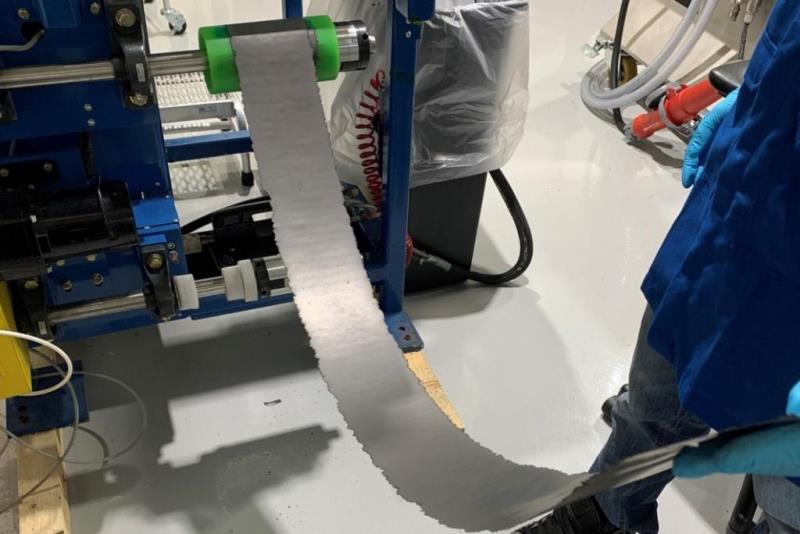
Dry electrode manufacturing could lead to cleaner, more affordable high-density EV batteries, according to U.S. Oak Ridge National Laboratory. That’s especially the case in lithium-ion battery factories, where they traditionally apply a wet slurry containing toxic solvents. We investigate a dry alternative that could save money, while reducing health and environment risks, if done correctly.
Oak Ridge Dry Electrode Research Ongoing
Oak Ridge National Laboratory is a federally-funded research and development center in Tennessee, United States. Scientists there conducted experiments suggesting ‘significant benefits’ from dry electrode battery assembly.
A July 2023 Oak Ridge report (see link below) summarized the advantages as follows:
- There are significant benefits to dry battery manufacturing as this eliminates the need for solvent.
- This delivers a less-durable battery that is lighter, but can retain high storage capacity.
- These benefits could increase electric vehicle adoption, while reducing carbon emissions.
This relatively new technology could save factory floor space too, while also reducing time, energy and waste disposal costs. Yet despite this, the Oak Ridge report concludes, “until now, researchers have had limited understanding of how and why it works”.
What Oak Ridge Discovered When it Probed
The team focused on how this novel electrode manufacturing method affects battery materials, and conductivity between cathode and anode. First, they mixed dry powders with a binder. Then they compacted this material to improve particle contact.
When they measured the electro-chemical performance of this product, they observed a ‘superb ability’ to maintain higher energy loading over time. They also noted how lithium ions ‘take a more direct path between the anode and cathode’.
Powder & Bulk Solids announced a new initiative involving AM Batteries in Massachusetts on April 15, 2024. AM are teaming with Zeon Corporation in Tokyo, Japan to develop a new binder for plating electrode current-collector foils.
More Information
Battery Electrode Roles – How They Flip
Thicker Electrodes for Smarter Batteries