Lithium-ion battery recycling in Europe faces challenges, because the chemistry is at the heart of the green debate. This discussion revolves around a key question. This question is how green should the mechanisms be, that we deploy to resist the creep of climate change? This is not something we should sweep under the carpet of denial.
Challenges Facing Lithium-Ion Battery Recycling in Europe
We gained our inspiration for this blog post, from a research paper by Aachen University in Germany, that we link to below. This document begins with reiterating the critical role of lithium-ion batteries, in the electric vehicle movement.
It continues with the observation that effective and profitable battery recycling processes are essential, if Europe is to reduce its dependence on imported lithium, cobalt, and graphite.
North America faces a similar dilemma as we write. We too need to increase the sustainability of the lithium, cobalt, and graphite that we import. We too, have to increase the effectiveness of lithium-Ion battery recycling in our own countries.
The Economic and Structural Challenges Facing Europe
Having described the prevailing situation as we outlined above, the Aachen University team move on to what they refer to as ‘economic and structural challenges’. These are the impediments that the advanced subcontinent faces, as it seeks to resolve the challenges of lithium-ion battery recycling.
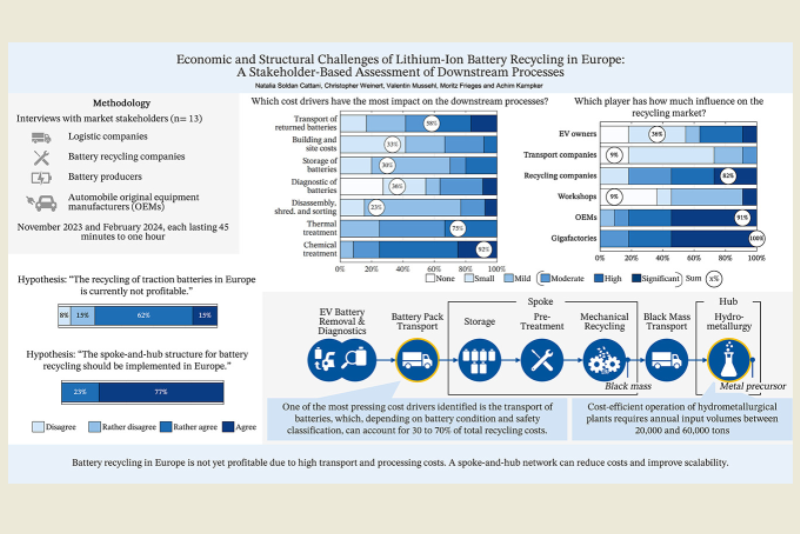
Their findings that follow below, are an amalgamation of 13 opinions from stakeholders in key industries. These sectors in the battery value chain include vehicle manufacturers, logistics providers and recycling companies:
- Current recycling practices are not profitable. Transport can account for up to 70% of total recycling costs.
- The chemical processing infrastructure requires investments of around 23 euros (27 dollars) per ton, of input material.
- Many recycling plants operate at less than 10% of their capacity, due to insufficient battery return volumes.
The team from Aachen University in Germany, proposes a decentralized structure. It visualizes ‘regional pre-treatment facilities and centralized chemical processing hubs, to reduce transport distances, lower costs, and improve scalability’ of battery recycling in Europe.
More Information
Greater Battery Recyclability in European Union
Tighter Control Of Black Mass Reserves in EU